


Table of Contents
- Why Cleansing Crystals Matters
- How to Cleanse Crystals at Home: 7 Methods That Work
- Crystals That Cannot Go in Water: A Safety Guide
- How to Charge Crystals After Cleansing
- How Often to Cleanse Crystals
- Eco-Friendly Cleansing Alternatives
- Troubleshooting Common Cleansing Mistakes
- How to Cleanse Crystals at Home: Final Thoughts
Last Updated: August 17, 2026
Crystal cleansing is the practice of clearing accumulated energetic residue from stones and minerals so they can function at their full vibrational frequency. Knowing how to cleanse crystals at home is one of the most foundational skills in any spiritual practice. This guide from Spill The Tea Sis Apothecary walks you through every method that actually works, flags the safety mistakes most beginners make, and gives you a clear framework for building a cleansing ritual that fits your life.
Below, you'll find seven distinct methods ranked by accessibility, a mineralogical safety chart for water-sensitive stones, and troubleshooting advice for the issues that trip people up most often.
Why Cleansing Crystals Matters
The metaphysical perspective holds that stones absorb emotional and energetic imprints from everyone who handles them, creating energy blockages that dull their properties over time. Spiritual hygiene is as essential as physical hygiene in this framework.
The scientific perspective is worth acknowledging honestly. Mineralogy confirms that crystals have measurable physical properties, piezoelectric effects in quartz are well-documented by researchers at institutions like the Mineralogical Society of America. Whether those properties translate into energetic clearing is a matter of personal belief. What's not debatable is that certain cleansing methods cause real physical damage to certain stones, and understanding the difference between metaphysical purification and mineralogical safety is essential before you begin.
A common mistake is treating all crystals as interchangeable. Purification rituals that are perfect for tumbled obsidian can dissolve selenite or bleach amethyst. The cleansing ritual you choose must match the stone you're working with.
How to Cleanse Crystals at Home: 7 Methods That Work
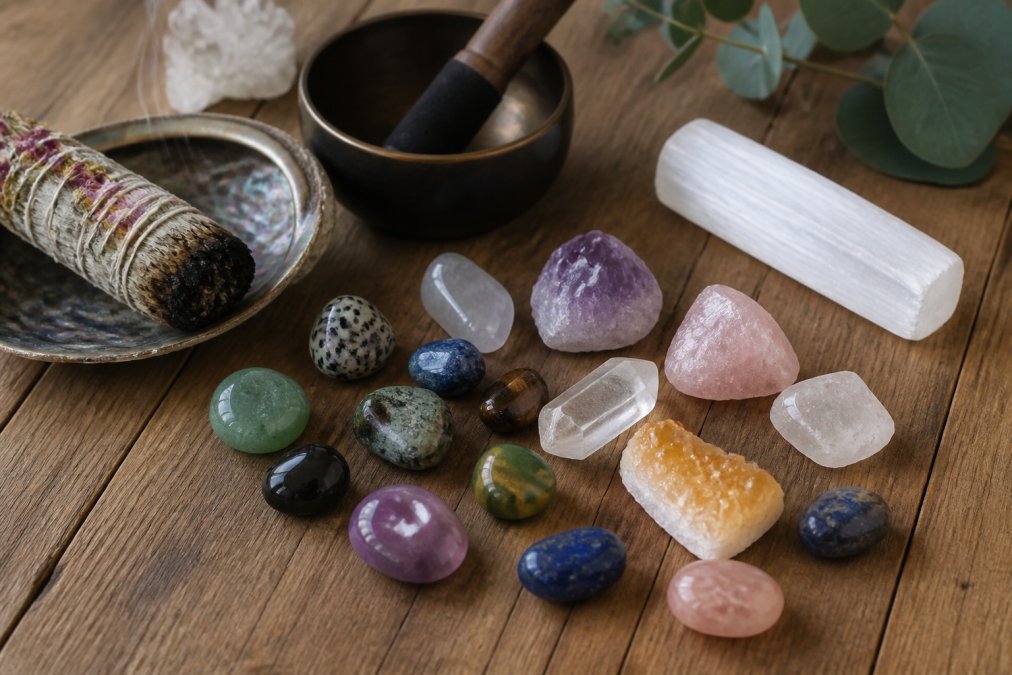
Seven methods cover the full range of what's practical for home practice. Some require nothing more than your breath and intention. Others use tools you may already own. The right method depends on the stone, your living situation, and how deeply you want to engage with the ritual.
| Method | Best For | Time Required | Water-Safe Required? |
|---|---|---|---|
| Moonlight | All crystals | 4-8 hours overnight | No |
| Running water | Hard, non-porous stones | 1-5 minutes | Yes |
| Smudging | All crystals | 3-5 minutes | No |
| Selenite charging plate | All crystals | 1-24 hours | No |
| Sound bath | All crystals | 5-15 minutes | No |
| Salt (dry) | Hardy, non-metallic stones | 1-24 hours | No |
| Breathwork and intention | All crystals | 1-3 minutes | No |
Moonlight and Sunlight
Moonlight is the safest and most universally applicable cleansing method. Place your crystals on a windowsill or outside under a full moon overnight, and the lunar light gently recharges their energy without any risk of physical damage. A full moon amplifies the effect, but any moon phase works for basic energy clearing.
Sunlight is more complicated. Direct sunlight charges certain stones beautifully, clear quartz and carnelian respond well to solar energy. However, many popular crystals including amethyst, rose quartz, and fluorite will fade noticeably after repeated sun exposure. UV light degrades the iron and manganese impurities that give these stones their color. Limit sun exposure to no more than 30 minutes for color-sensitive specimens, and default to moonlight when in doubt.
Running Water
Running water is one of the most intuitive cleansing methods: hold your crystal under a stream of cool, clean water for one to three minutes while visualizing negative energy washing away. Natural running water from a stream carries additional grounding energy, but tap water works perfectly well for regular maintenance cleansing.
The critical rule is simple: only use water on stones rated 6 or higher on the Mohs hardness scale that are also non-porous. Soft or porous stones will absorb water, swell, crack, or dissolve entirely. The full safety list appears in the dedicated section below.
Smudging with Sage or Palo Santo
Smudging is the practice of passing your crystals through the smoke of burning herbs or resins to clear stagnant energy. White sage is the most traditional choice, though palo santo, a sacred wood with a warm, resinous scent, has become widely used for crystal cleansing rituals. Incense made from frankincense or cedar works equally well.
To smudge a crystal:
- Light your sage bundle or palo santo stick and allow a steady stream of smoke to develop
- Hold the crystal in the smoke for 30 to 60 seconds, rotating it so all surfaces are exposed
- Set a clear intention as you work: what energy are you releasing, and what are you inviting in?
- Extinguish your smudge safely in a fireproof dish
Ventilate your space by opening a window before you begin. This gives the released energy somewhere to go.
Selenite and Crystal Grids
Selenite is unique among cleansing tools because it never needs to be cleansed itself. Its high vibrational frequency continuously radiates purifying energy, making it ideal for passive, ongoing crystal maintenance. Place any stone directly on a flat selenite charging plate or beside a selenite wand for one to 24 hours, and the energy clearing happens without any active effort on your part.
Crystal grids extend this concept by arranging stones in a geometric pattern with selenite at the center or corners to create a sustained field of activation energy.
Sound Bath with Singing Bowls
Sound healing works on a principle that's both metaphysical and physically measurable: vibration. Singing bowls, tuning forks, bells, and recorded sound baths produce resonant frequencies that practitioners believe dislodge stagnant energy from crystals. According to research published through the Journal of Evidence-Based Integrative Medicine, sound-based therapies produce measurable physiological responses in human subjects, which supports the broader idea that vibrational frequency affects physical systems.
To use a singing bowl:
- Place your crystals inside or around the bowl
- Strike or rim the bowl to produce a sustained tone
- Allow the vibration to continue for five to ten minutes
- Repeat with intention, focusing on energy clearing with each pass
This method works for every crystal without exception, making it the best default for anyone building a mixed collection.
Salt Cleansing (and When to Skip It)
Dry sea salt is a traditional purification medium with a long history in folk magic and spiritual practice. Bury hardy stones in a bowl of dry sea salt for several hours or overnight to draw out negative energy. Discard the salt after use rather than reusing it.
Never use salt water. The combination of moisture and salt is corrosive to many minerals and will damage metallic inclusions, soft stones, and any crystal with natural fractures. Stones to keep away from salt entirely: pyrite, hematite, selenite, calcite, and any stone with metallic veining.
Breathwork and Intention Setting
The simplest method requires nothing except your own breath and focused attention. Hold your crystal in both hands, close your eyes, and take three slow, deep breaths. On each exhale, direct your breath across the surface of the stone while visualizing stagnant energy dispersing. Then set a clear intention for what you want the crystal to carry going forward.
This method is underestimated. Intention setting is the foundation of every other cleansing ritual; the physical tools are amplifiers, not substitutes.
Crystals That Cannot Go in Water: A Safety Guide
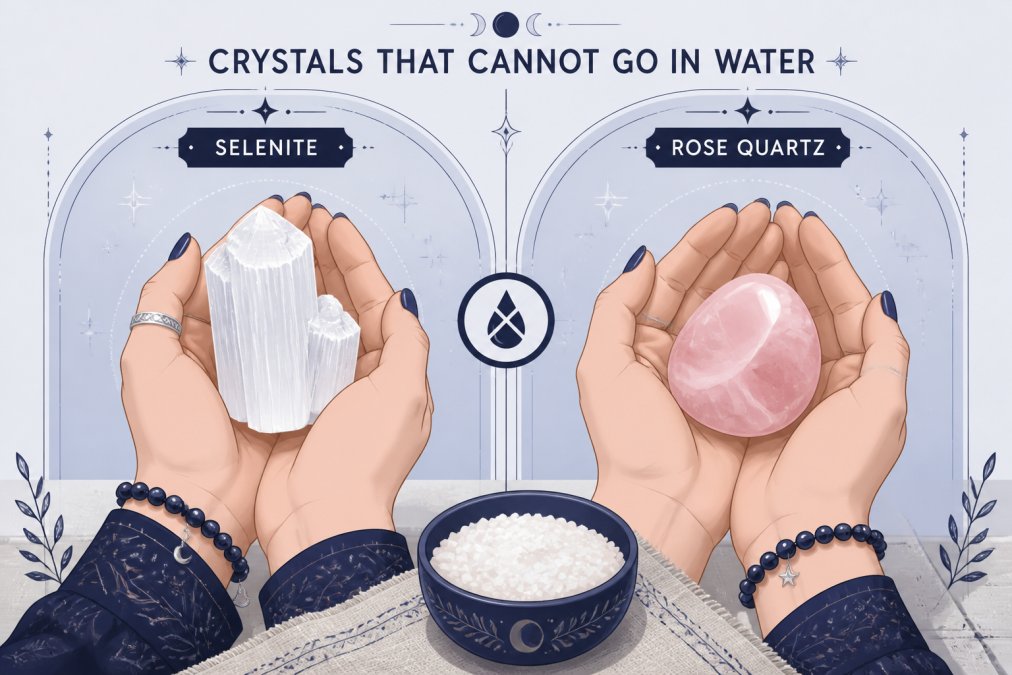
Crystals that cannot go in water include selenite, malachite, pyrite, calcite, kyanite, angelite, fluorite, celestite, and halite. Exposing these stones to water causes irreversible damage: dissolution, surface pitting, structural cracking, or toxic mineral release.
Understanding the Mohs Hardness Scale and Porosity
The Mohs hardness scale is a mineralogical ranking from 1 to 10 that measures a mineral's resistance to scratching. As a general guideline for water cleansing, stones rated below 6 on the Mohs scale are too soft for water exposure. Porosity matters equally: a stone can be hard but still absorb water through microscopic fractures or natural channels, which causes internal damage over time.
According to the Gemological Institute of America's gemstone resources, hardness and toughness are distinct properties, a stone can be hard but brittle, or soft but structurally stable. Both properties determine water safety.
| Crystal | Mohs Hardness | Water Safe? | Notes |
|---|---|---|---|
| Clear Quartz | 7 | Yes | Excellent for running water |
| Rose Quartz | 7 | Yes | Avoid prolonged soaking |
| Amethyst | 7 | Yes | Avoid sunlight after cleansing |
| Black Tourmaline | 7-7.5 | Yes | Brief rinse only |
| Selenite | 2 | No | Dissolves in water |
| Malachite | 3.5-4 | No | Can release toxic copper compounds |
| Pyrite | 6-6.5 | No | Oxidizes and crumbles |
| Fluorite | 4 | No | Soft and porous |
| Calcite | 3 | No | Dissolves readily |
| Kyanite | 4.5-7 | No | Highly variable, avoid water |
Stones to Keep Completely Dry
Some stones present a toxicological concern when wet. Malachite contains copper carbonate, and water exposure can cause surface deterioration that releases trace copper compounds. Similarly, cinnabar contains mercury sulfide and should never be submerged or handled without care.
The practical rule: if you're not certain a stone is water-safe, use moonlight, sound, or selenite instead. These methods work for every crystal without exception and carry zero risk of physical damage.
How to Charge Crystals After Cleansing
Charging crystals means actively directing energy into a stone after cleansing, rather than simply removing what's accumulated. Cleansing creates a blank slate; charging fills it with purpose. The most effective charging methods are moonlight on a full moon, sunlight for appropriate stones, placement on selenite, and direct intention work.
Setting Intentions During Activation
Intention setting transforms a passive charging session into an active ritual. Hold the cleansed crystal in your dominant hand, close your eyes, and state your intention clearly, either aloud or silently. Be specific: "I charge this stone to support clarity during creative work" is more effective than a vague request for "good energy."
Many practitioners write their intention on paper and place the crystal on top overnight. Others create a crystal grid with a central stone dedicated to the intention and surrounding stones amplifying it.
How Often to Cleanse Crystals
How often you cleanse crystals depends on how frequently you use them and what environments they're exposed to. Crystals used daily in meditation or carried in a pocket benefit from weekly cleansing. Display pieces in a stable home environment need cleansing monthly or when you notice they feel energetically dull or heavy.
Cleanse any crystal immediately after purchasing or receiving it, after an emotionally intense experience, during illness in the household, after being handled by multiple people, or when you intuitively feel it needs it.
Eco-Friendly Cleansing Alternatives
The most sustainable cleansing methods are also some of the most effective. Moonlight requires no materials at all. Sound baths with a singing bowl or tuning fork are entirely zero-waste. Breathwork and intention setting have no environmental footprint whatsoever.
Where eco-conscious choices matter most is in smudging. Wildcrafted white sage has faced overharvesting pressure in some regions, as noted by United Plant Savers, a nonprofit tracking at-risk native plants. Practical alternatives include garden-grown or ethically sourced loose sage, palo santo from suppliers with verified replanting programs, locally sourced cedar or lavender bundles, and loose incense resins like frankincense or copal.
Salt sourced from commercial food-grade suppliers is generally fine for occasional use, but discard used cleansing salt in the trash rather than outdoors, as salt-saturated soil harms plants.
Troubleshooting Common Cleansing Mistakes
The crystal feels the same after cleansing. The most common cause is distracted intention. Try again with focused breathwork first, then move to your chosen method.
A stone cracked or developed a white film after water cleansing. You've used water on a water-sensitive stone. Dry the stone immediately, then switch to moonlight or sound for future cleansing.
Smudging smoke sets off the smoke detector. Use a smaller smudge bundle and work near an open window. Alternatively, switch to a cold method: selenite, sound, or moonlight.
You don't know if a new crystal is water-safe. Default to moonlight or a sound bath. These methods work for every known mineral and carry no risk.
Your cleansing routine feels like a chore. Scale back to one simple method, even just breathwork and intention, and rebuild from there. Spiritual hygiene should feel like care, not obligation.
How to Cleanse Crystals at Home: Final Thoughts
The right approach to how to cleanse crystals at home is the one you'll actually do consistently. Moonlight and intention setting require nothing and work for every stone. Running water is fast and grounding for appropriate crystals. Sound baths and selenite plates handle the rest. The mineralogical safety guide isn't optional, protecting your stones from physical damage is as important as the energetic work itself.
At Spill The Tea Sis Apothecary, every crystal in our collection is curated with this kind of intentionality in mind. Whether you're building your first altar or deepening an established practice, the tools you work with matter, and so does how you care for them.
Frequently Asked Questions
Can you cleanse all crystals with water?
No. Water-soluble and porous stones can crack, dissolve, or lose their surface finish when submerged. Stones with a Mohs hardness below 6, such as selenite, malachite, pyrite, and kyanite, should never go in water. Safe alternatives include moonlight, sound baths, or placing them on a dry selenite charging plate. Always check a stone's hardness and porosity before using any water-based cleansing method.
How often should you cleanse your crystals?
A general rule is to cleanse crystals once a month, ideally around the full moon. Stones used in active healing work, worn daily, or placed in high-traffic spaces benefit from weekly cleansing. After a particularly heavy emotional session or a period of grief, cleanse immediately rather than waiting. New crystals should always be cleansed before first use to clear any energy they absorbed during handling and shipping.
What do you say while cleansing crystals?
There is no single required phrase. Most practitioners speak a simple, clear intention aloud, something like: 'I release all energies that no longer serve this stone's highest purpose.' The words matter less than the clarity of your focus. Hold the crystal, breathe slowly, and state what you are clearing and what you are inviting. Repeating the intention three times is a common practice in many cleansing rituals.
How do you activate crystals after cleansing them?
Activation, sometimes called charging, follows cleansing. Place the stone in direct moonlight overnight, set it on a selenite plate, or hold it in both hands and breathe your intention into it. Speak or mentally state the specific purpose you want the crystal to support, whether that is grounding, manifestation, or emotional healing. This intention-setting step aligns the crystal's metaphysical properties with your personal energy field.
Building a consistent cleansing practice is easier when you start with high-quality stones that come with genuine energetic integrity. Spill The Tea Sis Apothecary offers ethically sourced crystals, selenite charging tools, and intuitively chosen mystery crystal boxes designed to support exactly this kind of home practice. Shop with intention and bring the ritual home.
This article was written using GrandRanker