


Table of Contents
- How Manifestation Candles Work for Anxiety
- Best Candle Scents for Anxiety Relief
- Aromatherapy Benefits for Stress Reduction
- Manifestation Candle Rituals for Beginners
- What Candles Can and Cannot Do for Anxiety
- How to Choose a Manifestation Candle You Will Actually Use
- Frequently Asked Questions
Last Updated: September 10, 2026
How Manifestation Candles Work for Anxiety
Can manifestation candles really help anxiety? As a grounding ritual, yes, not as a treatment. The flame gives your eyes one steady place to rest, the scent signals safety to your nervous system, and setting an intention turns a vague, spiraling feeling into something you can name and hold. Customers describe a shift: less static, more room to breathe.
A candle won't lower your heart rate like medication, but it can anchor a calming routine you'll actually repeat, and repetition is where anxiety support lives.
What Makes a Candle a Manifestation Candle
A manifestation candle is a candle paired with a stated intention, so lighting it becomes a deliberate ritual rather than passive decoration. The candle itself is ordinary wax and wick; the intention is what you bring, written, spoken aloud, or held in mind as you strike the match.
What separates a manifestation candle from a plain one comes down to a few choices:
- A written intention you attach to the candle, not just a mood
- A scent chosen for a purpose, like calm, confidence, or release
- A repeatable moment (same chair, same hour) so your body learns the cue
- A closing action, such as blowing out the flame and naming one small next step
The candle is a container for attention. That's the whole mechanism, and it's enough.
The Science of Scent and the Nervous System
Scent reaches the brain faster than almost any other input because it bypasses the thalamus and connects directly to the limbic system, the region tied to emotion and memory. That's why a familiar smell can calm you before you've consciously registered it. Aromatherapy is best understood as a comfort and ritual practice rather than a proven medical treatment, and the National Center for Complementary and Integrative Health overview of aromatherapy notes that evidence for most essential oil claims is limited and mixed.
In practice: don't expect a candle to cure anxiety. Do expect a specific scent, used at the same time daily, to become a reliable signal that the day is winding down.
Best Candle Scents for Anxiety Relief
Lavender is the most studied scent for winding down, followed by chamomile, bergamot, and cedarwood.
A short guide to matching scent to mood:
| Scent | Best For | Feels Like |
|---|---|---|
| Lavender | Nighttime wind-down | Soft, quiet, familiar |
| Chamomile | Overstimulated evenings | Warm, gentle, slow |
| Bergamot | Restless, buzzing energy | Bright, lifted, clear |
| Cedarwood | Grounding after a hard day | Steady, earthy, held |
| Eucalyptus | Tension and tightness | Open, cool, reset |
If unsure where to start, pick the scent that reminds you of a place you already feel safe. Memory does more work here than any label claim.
Aromatherapy Benefits for Stress Reduction
Aromatherapy benefits for stress reduction come mostly from the ritual and the memory associations a scent carries, with some supportive evidence for calming scents like lavender. The Cleveland Clinic's guidance on aromatherapy frames it as a complementary practice, useful alongside other coping tools rather than instead of them.
Here's what that looks like honestly:
- A scent you love can lower the feeling of urgency in a room within minutes
- The same scent used nightly becomes a cue your body expects
- A candle forces you to sit still for a set period, which is its own benefit
- None of this replaces therapy, medication, or medical care when you need them
The candle is a tool for the moment. The routine is what compounds.
Manifestation Candle Rituals for Beginners
Manifestation candle rituals for beginners work best when they're short, repeatable, and done at the same time each day. Ten minutes is plenty. The goal isn't a perfect ceremony; it's a cue your nervous system can learn.
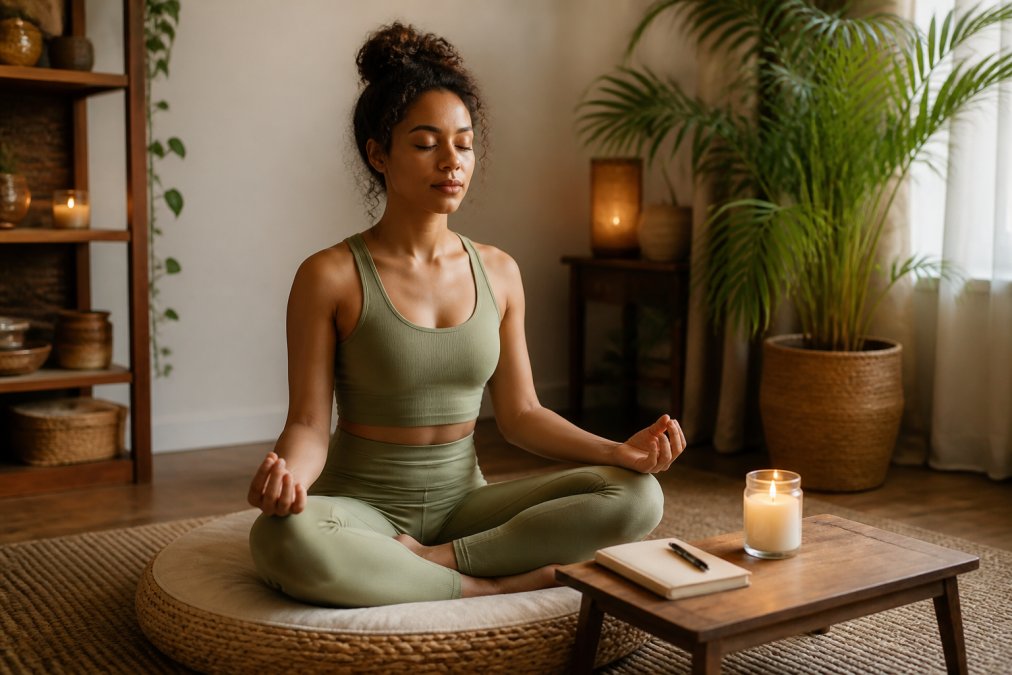
Start with these ground rules:
- Pick one candle and one scent. Don't rotate yet.
- Choose a fixed time, ideally within an hour of the same point each evening.
- Keep a pen and a small notebook within reach.
- Silence your phone or leave it in another room.
- Set a timer for ten minutes so you're not watching the clock.
A Simple 10-Minute Evening Ritual
- Dim the lights and light your candle. Watch the flame for thirty seconds before doing anything else.
- Write one intention in a single sentence. Present tense, specific, and kind to yourself.
- Read it aloud once, slowly. Say it like you mean it, because you do.
- Sit and breathe for five minutes. In through the nose, out through the mouth, longer on the exhale.
- Name one small action for tomorrow. One step, not a plan.
- Blow out the candle and close the notebook. That's the signal the ritual is done.
When the Ritual Feels Blank (and What to Do)
Most beginners hit a night where the candle is lit, the intention is written, and nothing happens. The mind stays loud, the scent feels like nothing, and you close the notebook feeling like you failed at relaxing. This is the most common reason people quit within two weeks.
A blank ritual is not a sign the practice doesn't work for you. It usually means one of four things:
- The intention is too big. "I want to stop being anxious" is not a ten-minute intention. Shrink it until it fits: "I want to notice one calm breath before bed."
- The scent is wrong for the moment. A bright citrus candle at 10 p.m. can keep you alert when you're trying to wind down. Match the scent to the hour, not just the mood.
- You're watching yourself too closely. Checking whether the ritual is working is its own form of anxiety. Boredom is often the first sign your body is settling.
- The timing is off. If you're lighting the candle after you're already exhausted, the ritual becomes one more task. Try moving it twenty minutes earlier, before the last scroll of the night.
A useful troubleshooting move: for one week, drop the intention and just sit with the candle for five minutes. If the ritual comes back to life, the intention was the problem, not the candle. If it still feels flat, the issue is timing or scent.
Reading Your Own Candle Behavior
You don't need to believe in omens to get useful information from how a candle behaves. Treat the flame as a mirror for your own state, not a message from outside.
- A steady, tall flame usually means the room is still and you are still. Notice that.
- A flickering, dancing flame often tracks a draft, but it also tracks restless breathing. If the flame settles when your exhale lengthens, you've watched your nervous system downshift in real time.
- A flame that keeps drowning in wax means the wick needs trimming, not that your intention is blocked. Trim to about a quarter inch before each light.
- A tunneled candle (wax burning down the middle, walls left high) usually means the first burn was too short. Let the first burn last long enough for the melt pool to reach the edge, typically one to two hours for a standard jar.
This is the same skill tarot readers use when they move past memorized keywords and start reading the imagery in front of them. The candle is your imagery. The behavior is the reading.
A Two-Week Starter Schedule
If you want structure instead of guesswork, try this:
- Days 1-3: Light the candle, watch the flame for two minutes, blow it out. Nothing else. You're building the cue.
- Days 4-7: Add the written intention and read it aloud once.
- Days 8-10: Add the five minutes of breathing.
- Days 11-14: Add the one small action for tomorrow.
By the end of two weeks, the sequence should take about ten minutes and feel less like a task and more like a signal. If it doesn't, go back a step. The schedule is a scaffold, not a test.
What Candles Can and Cannot Do for Anxiety
A candle can support a calming routine. It cannot treat an anxiety disorder, and no scent or ritual replaces professional care. If anxiety is interfering with sleep, work, relationships, or daily functioning, talk to a doctor or licensed therapist, not to buy more candles.
Where candles genuinely help:
- They create a physical cue that the day is ending
- They slow you down for a fixed period
- They pair a scent with a repeated, calming moment
- They give an abstract feeling a concrete object to hold
Where they don't:
- They won't manage panic attacks
- They won't replace therapy or medication
- They won't work if you never actually sit with them
How to Choose a Manifestation Candle You Will Actually Use
The best manifestation candle is the one whose scent you love and whose price you won't resent burning. If you don't enjoy the smell, you won't light it, and an unused candle helps no one.
A quick checklist before you buy:
- Smell it first if you can. Online, read the full scent description, not just the name.
- Check the wax. Soy and other plant-based waxes tend to burn cooler and slower than paraffin.
- Match the intention to the moment. A confidence candle for mornings, a calming one for nights.
- Consider the wick. Cotton wicks burn more predictably than metal-core ones.
- Start with one. Add a second only after the first becomes a habit.
How to Judge a Candle Before You Burn It
Most buying guides stop at the scent, but construction matters just as much. You can evaluate it in about thirty seconds:
- Wick placement. A centered, straight wick burns evenly. An off-center wick tunnels and wastes wax.
- Wick thickness. A wick too thin for the jar will drown; too thick and it will smoke. A well-matched wick produces a flame roughly an inch to an inch and a half tall with no black smoke.
- Jar diameter. Wider jars need larger wicks and longer first burns. For a ten-minute ritual, a narrow jar is easier to maintain than a wide three-wick bowl.
- Scent strength at cold. A candle that smells strong unlit usually smells strong lit. A candle that smells faint cold often disappears entirely once burning.
- Label honesty. "Made with essential oils" does not mean "only essential oils." If a specific oil matters to you, look for it named on the label.
When to Replace a Candle
A candle that has stopped performing isn't a failed ritual, it's just done its job. Replace it when:
- About half an inch of wax remains. Burning below that risks overheating the jar and, on some containers, cracking the glass.
- The wick won't stay lit even after trimming and clearing debris.
- The scent has gone flat. This is common in candles stored in warm rooms or kept past a year.
- The wax has pulled away from the glass or developed a visible crack. That's a sign of temperature damage, not a spiritual one.
People often keep a candle past its useful life because they feel attached to the intention written on it. If that's you, transfer the intention to the new candle. The ritual lives in the repetition, not the object.
Matching Candle Type to Your Routine
Different formats suit different rituals:
- Jar candles are the default for a ten-minute evening sit. They hold scent well and are easy to extinguish.
- Pillar candles work for longer, slower sessions but need a plate and more attention to burn evenly.
- Tealights are useful for short, frequent check-ins, but they burn hot and fast and are not ideal for a full ten-minute breathing session.
- Tapers are best for a table setting or a written intention you read aloud, not for a floor cushion.
For a nightly habit, one jar candle used consistently does more than three formats rotated at random.
Our Soothe Your Soul Intention Candle is a calming soy wax pick built for exactly this kind of evening ritual, and the No Rain No Rainbow candle was made for heavier seasons like grief and loss. If confidence is the intention you're working on, the Own It Bitch Empowerment Candle was our very first pour and still our best seller. Any of them works as a beginner's first candle; the scent you reach for is the right one.

Frequently Asked Questions
Do manifestation candles actually work for anxiety?
Manifestation candles are not a treatment for anxiety, but they can support a calming routine. The ritual of lighting a candle, focusing on an intention, and breathing slowly gives your mind a single anchor point. That structure, combined with a soothing scent, can lower day-to-day stress. Think of it as a mindfulness tool that pairs well with, rather than replaces, professional care.
What candle scents are best for reducing anxiety?
Lavender, chamomile, eucalyptus, and cedarwood are common choices for calming. Coastal and ocean-inspired scents also work well because the association with fresh air and open water signals safety to the brain. If you are unsure where to start, pick one scent you already find comforting and use it only during your wind-down routine so your brain links that smell with relaxation.
What is the difference between a regular candle and a manifestation candle?
A regular candle is made for light or decoration. A manifestation candle is poured with a stated purpose, often tied to a specific intention like peace, confidence, or healing. The difference is mostly in how you use it. You set an intention before lighting, keep that intention in mind while the candle burns, and treat the ritual as a repeated practice rather than one-off ambiance.
How do I start a manifestation candle ritual if I am a total beginner?
Pick a quiet time, ideally in the evening. Write one sentence describing how you want to feel, such as calm or grounded. Light your candle, read the sentence out loud, then sit and breathe for five to ten minutes. Snuff the candle instead of blowing it out, and repeat the same routine for a week. Consistency matters more than any specific technique.
Anxiety rarely responds to a single fix. It responds to small, repeated moments of safety, and a candle ritual is one of the easiest to build. Spill The Tea Sis Apothecary handcrafts intention candles designed for exactly that kind of daily practice, from calming soy wax blends to confidence and grief-support pours. Shop with intention and give yourself one steady ten minutes a day.