


Table of Contents
- What to Expect as a Tarot Beginner
- Choosing Your First Tarot Deck
- How to Cleanse Tarot Cards with Intention Candles
- Your First Card Draw: A Simple 3-Card Spread
- Simple Tarot Spreads for Daily Guidance
- How to Interpret Tarot Cards for Beginners
- Common Beginner Mistakes and How to Avoid Them
- Building Your Daily Tarot Ritual
- Frequently Asked Questions
Last Updated: September 9, 2026
What to Expect as a Tarot Beginner
A beginner guide to using tarot cards is really a guide to talking with your own intuition. Tarot is a reflective practice, not a fortune-telling shortcut. The cards give you a mirror: they surface thoughts and feelings you already carry, just below the surface, so you can look at them with fresh eyes.
Most new readers expect to memorize 78 card meanings before touching a deck. That approach leads to burnout. The far better path is to start with one card, one question, and one honest look at what the imagery stirs in you. At Spill The Tea Sis Apothecary, we encourage beginners to treat the deck as a journaling partner rather than a textbook.
Here is the truth that changes everything: you do not need to know every card to do a meaningful reading. You need a deck you connect with, a quiet ritual, and a willingness to notice what you feel.
Choosing Your First Tarot Deck
Your first deck should feel like it belongs in your hands. The Rider-Waite-Smith is the classic starting point because its imagery is the visual language most guidebooks reference. But if its 1909 illustrations do not move you, choose a deck whose art speaks to your personal aesthetic. A deck you find beautiful will get picked up far more often than one you tolerate.
Look for a deck that includes a guidebook. Many modern decks ship with companion texts that explain each card's symbolism, which is invaluable when you are learning. The Major Arcana cards, the 22 archetypal figures like The Fool and The Sun, will likely appear in your readings most often at first, so find a deck where those images feel resonant to you.

Consider the physical size, too. If you have smaller hands, a standard deck can feel unwieldy during a shuffle. Some publishers offer mini editions that are easier to handle.
How to Cleanse Tarot Cards with Intention Candles
Cleansing a new tarot deck is about clearing stagnant energy and setting an intention for your practice. While many guides mention smoke or crystals, the most effective approach combines a physical cleanse with a clear, spoken intention. At Spill The Tea Sis Apothecary, we recommend a simple four-step ritual that takes under ten minutes.
Step 1: Clear the physical residue. New decks often carry a factory coating or dust. Gently fan the cards face-down and tap the edges on a soft surface to dislodge any particles. Some readers also wipe each card with a dry, lint-free cloth. This is a practical first step that most guides overlook.
Step 2: Set your space and light your candle. Choose a quiet spot where you won't be interrupted. The Moon Tarot Candle, with its focus on intuition and trusting your inner voice, pairs naturally with this ritual. Light the candle and take three slow breaths. The scent creates a consistent sensory anchor: each time you light it before a reading, your mind shifts into a focused, open state.

Step 3: Pass the deck through the flame's energy (not the flame itself). Hold the deck in your non-dominant hand and pass it clockwise three times around the candle flame, keeping it a safe distance above or beside the wick. As you do this, state aloud what you want your readings to serve: clarity, self-discovery, or gentle guidance. Speaking the intention out loud is the mechanism that makes the cleanse stick, it moves the practice from superstition to focused ritual.
Step 4: Knock or tap to reset. After the candle pass, give the deck three firm taps on its back with your knuckles. This is an old reader's trick to "wake up" the cards and signal that the cleanse is complete. Place the deck on a clean cloth or your altar space and let the candle burn for at least fifteen minutes while you sit with your intention.
How often should you cleanse? You do not need to cleanse the deck after every use. Do it when the deck feels heavy, after a particularly intense reading, or simply when you first bring it home. A practical rule of thumb: cleanse at the new moon as a monthly reset, and anytime you feel a sense of drag or resistance when shuffling. Trust your own sense of when the cards feel "off."
What if you don't have a candle? Moonlight is a powerful alternative. Leave the deck on a windowsill overnight during a full moon. If that is not possible, a simple visualization, imagining a white light washing over the cards, works for many readers. The mechanism matters less than the consistency of your ritual.
Your First Card Draw: A Simple 3-Card Spread
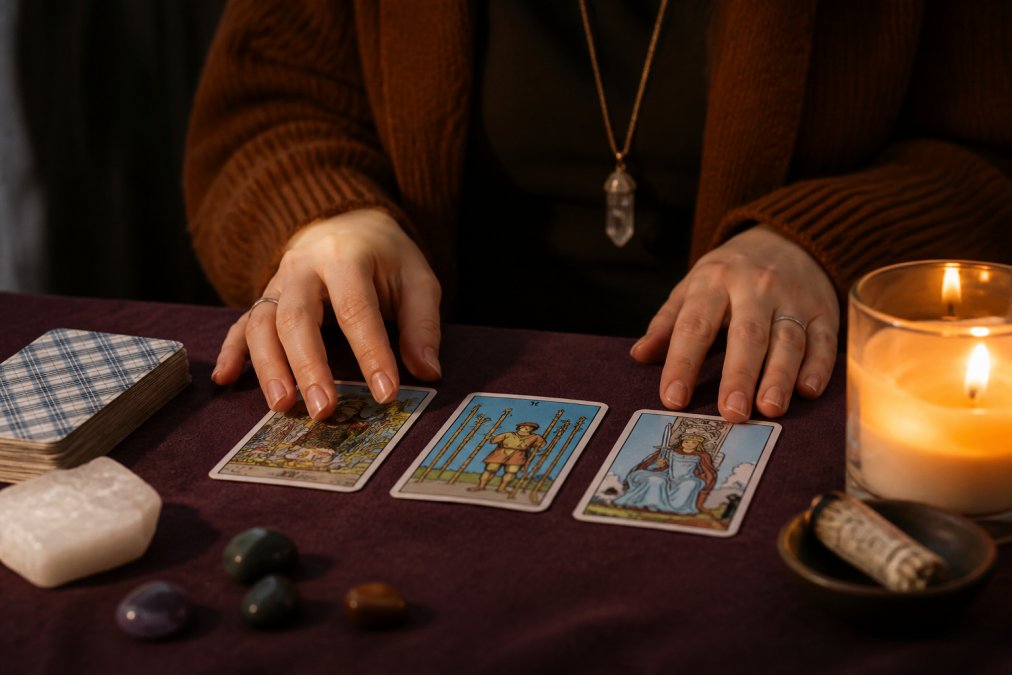
The 3-card spread is the ideal starting point because it is structured enough to guide you yet open enough to let intuition breathe. Shuffle the deck while thinking of a question, then cut it into three piles. Draw one card from each pile and lay them left to right.
A classic beginner layout assigns each position a meaning:
- Card 1: The Situation - What is happening right now
- Card 2: The Challenge - What is blocking or testing you
- Card 3: The Guidance - What action or mindset will help
Read the cards as a conversation rather than three separate fortunes. Does the imagery in Card 3 echo a symbol from Card 1? That echo is often where the real message lives. If a card's meaning feels unclear, describe what you see in the picture out loud. Naming the colors, figures, and objects usually unlocks a personal interpretation no guidebook could give you.
Simple Tarot Spreads for Daily Guidance
Simple tarot spreads for daily guidance work best when they fit into a five-minute window. The single-card daily draw is the foundation: each morning, pull one card and sit with its message for the day. You might ask, "What energy should I carry today?" or "What do I need to notice?"
The one-card draw is a daily mindfulness practice, not a full reading. Keep a journal nearby and write one sentence about the card. Over weeks, this becomes a record of patterns: which suits appear most often, which Major Arcana figures keep showing up, and how your interpretations evolve.
For slightly deeper guidance, try the "Mind, Body, Spirit" spread with three cards. Card 1 represents your mental state, Card 2 your physical energy, and Card 3 your spiritual well-being. This spread works well on Sundays as a weekly check-in. The Suit of Cups often appears in the spirit position, while the Suit of Swords frequently shows up for mental clarity, but let the cards speak for themselves rather than forcing a formula.
How to Interpret Tarot Cards for Beginners
Learning how to interpret tarot cards for beginners means balancing two skills: knowing the traditional keywords and trusting your felt response. Start with the keywords as a safety net, then let the imagery take over. The Suit of Wands relates to passion and action, the Suit of Cups to emotion and relationships, the Suit of Swords to thought and conflict, and the Suit of Pentacles to work and material life. The Court cards, such as Pages, Knights, Queens, and Kings, often represent people or aspects of your own personality.
Reversed card meanings, when a card appears upside down, intimidate many beginners. You can choose to read reversals as a softening or blocking of the card's upright energy. The Sun reversed might suggest joy that is being held back rather than joy that is absent. If reversals feel overwhelming at first, simply turn the card upright and read its core message. Many experienced readers skip reversals entirely.
What most guides miss is that card interaction matters more than individual meanings. A single card changes when placed beside another. The Empress, a card of abundance, reads differently next to the Tower, a card of sudden change, than it does beside the Two of Cups. Notice how the cards modify each other rather than interpreting each in isolation.

The visual symbolism method: reading the picture, not the keyword.
Here is the unique angle that separates intuitive readers from keyword robots: learn to read the Rider-Waite-Smith imagery as a visual language. Every element in the picture is a deliberate symbol placed there by artist Pamela Colman Smith. When you encounter an unfamiliar card, do not reach for the guidebook first. Instead, ask yourself these five questions:
-
What is the figure doing? Action tells the story. In the Eight of Cups, a figure walks away from eight stacked cups toward mountains. The action is departure, leaving something behind to seek higher ground. The keyword "moving on" comes from the action, not the other way around.
-
What colors dominate? Color carries emotional weight. Bright yellows signal optimism and clarity (The Sun, the Ace of Wands). Deep blues suggest introspection or emotional depth (the High Priestess, the Queen of Cups). Muted grays and browns often indicate stagnation or earthiness. Notice the dominant color before you read a single word.
-
What direction is the figure facing? Left-facing figures often look toward the past or the subconscious. Right-facing figures look toward the future or conscious action. The Fool faces left in most decks, suggesting a leap into the unknown from a place of inner trust. This directional cue is almost never taught in beginner guides.
-
What objects repeat or stand out? In the Rider-Waite-Smith system, objects are never decorative. The roses on the Five of Wands are not just pretty, they symbolize the creative energy that can emerge from chaos. The grapes on the Nine of Cups represent abundance and indulgence. If an object appears in the foreground or is unusually large, it is the message.
-
What is the figure's posture and expression? A figure with arms crossed (the Two of Swords) signals defensiveness or a deliberate refusal to see. A figure with arms open (the Star) signals receptivity and gratitude. Posture is body language, and body language is honest.
A practical exercise to build this skill.
Pull a card you do not know well. Cover the card's title with your thumb. Spend two minutes describing only what you see: the colors, the figures, the objects, the direction of movement. Write it down. Then uncover the title and compare your description to the traditional meaning. You will often find that your visual reading is 80% accurate without any keyword memorization. This exercise builds the intuitive muscle that makes readings feel alive rather than mechanical.
Common Beginner Mistakes and How to Avoid Them
The most common beginner mistake is asking the same question repeatedly until you get an answer you like. This drains the practice of meaning. Tarot is a tool for reflection, not a vending machine for reassurance. Ask once, sit with the answer, and resist the urge to reshuffle for a "better" outcome.
A second mistake is reading for others too soon. Reading for yourself lets you make mistakes privately and build confidence. When you do read for someone else, avoid making definitive predictions about health, finances, or legal matters. Ethical tarot reading offers guidance and perspective, never absolute declarations about events outside your control.
A third trap is abandoning the deck after a few confusing readings. A "blank" reading, where the cards seem to say nothing, usually means you are forcing a question that does not matter to you yet. Change the question, or simply pull a card and journal about its imagery without trying to force a meaning.
Building Your Daily Tarot Ritual
Consistency matters more than intensity. A daily tarot ritual of one card and three journal sentences will teach you more than a marathon two-hour session once a month. Choose a regular time, whether with morning coffee or before bed, and create a small altar space with your deck, a journal, and a candle.
The Sun Tarot Candle, with its message of stepping into your power and radiating your authentic self, makes a fitting companion for morning draws. Its warm, grounding scent signals to your mind that it is time to shift into reflective mode. The ritual of lighting the candle, shuffling the deck, and drawing a single card becomes a sacred pause in an otherwise busy day.
Remember that your relationship with tarot will evolve. The beginner guide to using tarot cards you follow today will feel simple in a year, and that is the point. You are not collecting card meanings; you are building a conversation with your own inner wisdom that deepens the more you show up for it.
Frequently Asked Questions
Do I need to memorize tarot card meanings?
No, and you shouldn't try to. Memorizing all 78 cards is overwhelming and can block your intuition. Start with the Major Arcana and focus on the imagery and symbolism in each card. As you practice, you will naturally learn the keywords for each card. A daily draw is the best way to build this knowledge slowly. Over time, your personal associations with the cards will become stronger than any book definition.
How often should I practice tarot card readings?
For beginners, a daily draw is the most effective practice. Pulling one card each morning is a low-pressure way to build a habit and learn the cards. As you get more comfortable, you can start using simple tarot spreads for daily guidance or weekly check-ins. The goal is consistency, not marathon sessions. A few minutes each day will teach you more than a long reading once a month.
Can I use intention candles during a tarot reading?
Yes, intention candles are a wonderful addition to a tarot practice. Light a candle to set the mood and focus your energy before you shuffle. For example, The Moon Tarot Candle is perfect for deepening intuition, while The Sun Tarot Candle can boost confidence in your readings. The ritual of lighting a candle signals to your mind that you are entering a sacred space for guidance.
How do I choose my first tarot deck?
Choose a deck that you feel drawn to visually. The imagery is your primary tool for interpretation, so you need to connect with the art. The classic Rider-Waite-Smith deck is a great starting point because most books and online resources reference its symbolism. However, if another deck's artwork speaks to you, that is the right one. Your intuition is the best guide when selecting a deck.
Starting your tarot practice does not require perfection, only presence. The cards will meet you wherever you are. At Spill The Tea Sis Apothecary, we offer tarot decks, intention candles, and handcrafted tools to support your journey toward self-discovery and intuition. Shop with intention and let your first card draw be the beginning of a conversation with yourself that lasts a lifetime.