


Table of Contents
- Define Your Intention Before You Begin
- Simple Spiritual Rituals for Beginners
- Create a Sacred Space for Your Practice
- Spiritual Ritual Tools for Home
- How Long Should a Daily Ritual Take
- Build Your Spiritual Morning Routine Ideas
- Troubleshooting Ritual Burnout and Staying Consistent
- The Neuroscience Behind Why Daily Rituals Work
Last Updated: August 30, 2026
Define Your Intention Before You Begin
Starting a daily spiritual ritual begins with clarity about why you're doing this. Your intention is the foundation everything else rests on. Without it, you're going through motions. With it, you have direction.
An intention isn't a goal you're chasing. It's a quality you're inviting into your life right now. Maybe you want more peace, connection to something larger than yourself, or to ground yourself before a chaotic day. These aren't things you'll achieve in six months, they're things you cultivate every single day.
According to research on mindfulness practices, people who define a clear purpose for their practices experience significantly higher consistency and reported well-being. Your intention becomes the anchor that brings you back when life gets busy.
Here's what makes intention-setting different from wishful thinking: specificity. Instead of "I want to be more spiritual," try "I want to start my day feeling grounded and present." The more specific your intention, the easier it is to recognize when your ritual is actually working.
Simple Spiritual Rituals for Beginners
Not every spiritual ritual needs to take an hour. The best daily spiritual ritual for you is one you'll actually do.
Morning Centering Ritual
A morning centering ritual sets the tone for your entire day. You're creating a pocket of intentional time where you're present with yourself.
Here's a simple structure:
- Sit quietly for 2-3 minutes. Find a spot where you won't be interrupted. Close your eyes or soften your gaze.
- Take five deep breaths. Breathe in for a count of four, hold for four, exhale for four. This activates your parasympathetic nervous system and signals safety to your body.
- State or think your intention. Say it out loud or silently. "I move through today with presence." "I choose peace." Whatever resonates with you.
- Notice one thing you're grateful for. Your coffee. Your bed. The fact that you woke up. Gratitude shifts your nervous system toward appreciation.
- Open your eyes and move forward. You've created your centering. Now live it.
This takes five to ten minutes and is effective because it's doable every single morning.
Evening Reflection Ritual
Your evening reflection ritual is when you process the day and create space to notice what happened and learn from it.
An evening reflection ritual might look like this:
- Light a candle or incense. This marks the transition from doing to reflecting. The sensory shift helps your mind recognize something different is happening. Spill The Tea Sis Apothecary's Incense Sticks are designed specifically for ritual, cleansing, and intention-setting.
- Sit with your journal. Write three things: one thing that went well, one thing that was difficult, one thing you learned. Three sentences per item is plenty.
- Ask yourself what you need tomorrow. More rest? More boundaries? More laughter? Write that down too.
- Close your journal and let the day go. You've acknowledged it. You've learned from it. Now you're done.
This takes ten to fifteen minutes and creates closure so you can actually rest.

Create a Sacred Space for Your Practice
Your sacred space doesn't need to be a separate room or fancy. It needs to be yours, a physical area where your mind knows that something intentional happens. Over time, your nervous system will recognize the space and settle more quickly when you enter it.
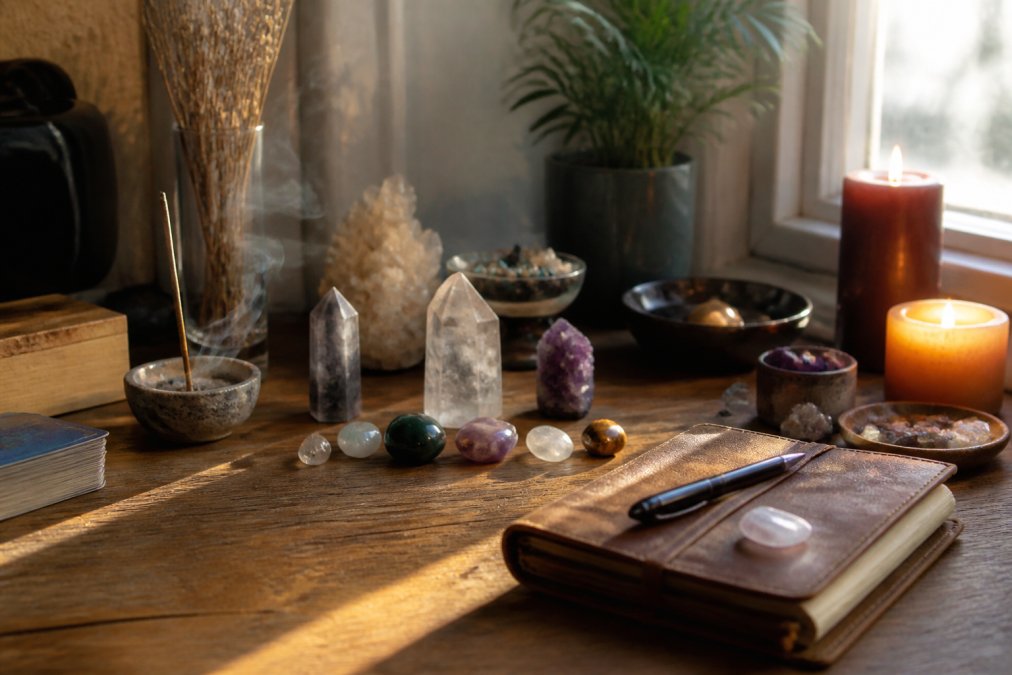
Here's how to create one:
Start small. A corner of your bedroom works. A spot on your kitchen table works. Even a designated cushion in your living room works.
Add one anchor object. This signals to your brain that you're entering sacred time. A candle. A crystal. A specific cloth. Spill The Tea Sis Apothecary's Wild Woman Divine Feminine Goddess Candle serves this purpose beautifully as a ritual tool and reminder of your intention.

Keep it clean. Clear enough that when you sit down, you're settling in, not moving things around.
Make it yours. Add whatever calls to you. Crystals. Plants. Photos. A specific color cloth. Your sacred space should feel like it belongs to you.
Environmental psychology shows that spaces designated for specific practices help our brains enter those states more easily. Your brain learns to associate the space with the ritual, and over time, simply sitting there begins to calm your nervous system.
Spiritual Ritual Tools for Home
The right tools make your daily spiritual ritual feel more intentional.
Candles mark time and create atmosphere. They're a focal point for your attention that shifts your state.
Incense and herbs engage your sense of smell, which connects directly to your limbic system. Different scents create different shifts. Sandalwood for grounding. Lavender for calm. Cedar for clearing. Spill The Tea Sis Apothecary's Incense Sticks offer ritual-grade options that support cleansing, grounding, and intention-setting.
Crystals serve as touchstones. Holding a crystal during your ritual gives your hands something to do and your mind something to focus on. Amethyst for calm. Black tourmaline for grounding. Rose quartz for softness.
A journal is where your reflections become real. Writing shifts thoughts from abstract to concrete and helps you track patterns.
An intention stirring spoon turns your morning coffee or tea into a ritual moment. An Intention Stirring Crystal Spoon means you're not just drinking, you're stirring intention into your day.

Choose tools that feel meaningful to you. If a crystal doesn't call to you, skip it. If you hate incense, don't force it. Your daily spiritual ritual works because it feels authentic.
How Long Should a Daily Ritual Take
Your daily spiritual ritual can be as short as five minutes and still be powerful. The length matters far less than the consistency.
A five-minute ritual might be: light a candle, take three conscious breaths, state your intention, and move on. A fifteen-minute ritual might add journaling or meditation. A thirty-minute ritual might include all of the above plus movement or divination.
Choose a length you can actually maintain. If you commit to thirty minutes and life gets chaotic, you'll skip it. If you commit to five minutes and you actually do it every day, you're building something real.
Research on habit formation shows that consistency matters more than duration. A five-minute ritual you do every day creates more change than a thirty-minute ritual you do twice a week.
Build Your Spiritual Morning Routine Ideas
Your spiritual morning routine sets the trajectory for your entire day. You're creating a foundation of presence.

Here's a structure that works:
Before you check your phone. Your phone is designed to fragment your attention. Your morning ritual is designed to gather it. Protect those minutes before you open your phone.
Start with water or tea. Hydrate your body. If you drink tea, use your Intention Stirring Crystal Spoon to stir it mindfully. You're turning a mundane action into a ritual.
Sit with your intention. Spend two to five minutes with your intention. You can meditate, journal, or simply sit quietly. The form matters less than the presence.
Move your body slightly. A few stretches or a short walk brings you into your body and out of your head.
Set one intention for the day. Not ten goals. One thing you want to carry with you. "I choose patience today." "I move with presence."
Then start your day. Now you can check your phone. You've already created your foundation.
Mornings are when you have the most control over your environment and attention. Use that to maintain consistency.
Troubleshooting Ritual Burnout and Staying Consistent
Ritual burnout happens when your practice stops feeling like presence and starts feeling like obligation. You're going through the motions without feeling anything.
The fix is simple: change something. Not everything. One thing. If you've been meditating, try journaling instead. If you've been using the same candle, try a different scent. Small shifts prevent staleness.
Remember why you started. What were you looking for? Peace? Grounding? Connection? Notice whether you've actually found more of that. You probably have, even if it's subtle.
Reduce if you need to. If your ritual has grown to thirty minutes and you're skipping it, cut it to ten. A ritual you actually do beats a perfect ritual you don't.
Track what's working. Keep a simple note of how you feel after your ritual. Just: "felt calm," "felt scattered," "felt present." Over time you'll notice patterns and see what actually shifts your state.
Research on behavioral consistency shows that people who track their practices maintain them longer. A simple checkmark on a calendar works.
The Neuroscience Behind Why Daily Rituals Work
Understanding why your daily spiritual ritual actually works makes it easier to trust the process, especially on days when you don't feel anything.
Your brain is a prediction machine constantly trying to anticipate what's coming next. When your environment is unpredictable, your nervous system stays activated. A daily spiritual ritual is predictable. Your brain learns the pattern and signals safety. Your nervous system downregulates. Cortisol drops. You move into a calmer state.
According to neuroscience research on ritual and the brain, repetitive, intentional practices activate the parasympathetic nervous system, responsible for rest, digestion, and calm. This is measurable. Your heart rate slows. Your breathing deepens. Your body chemistry shifts.
The sensory elements matter too. Incense engages your olfactory system, which connects directly to your limbic system. A candle gives your eyes something to focus on, which naturally calms your mind. Touch grounds you in your body.
Over time, these practices literally rewire your nervous system. You're training your brain to access calm more easily. Research from the American Psychological Association shows that people who maintain consistent spiritual practices experience measurable improvements in stress resilience, emotional regulation, and overall well-being.
Your daily spiritual ritual works because your brain and body are designed to respond to repetition, intention, and sensory input. You're using biology to create change.
Starting a daily spiritual ritual is about creating a practice that actually fits your life. Begin small. Choose tools that feel authentic to you. Show up consistently. The ritual itself becomes the transformation.
At Spill The Tea Sis Apothecary, we believe your daily spiritual practice deserves tools that honor your intention. Our Incense Sticks, Intention Stirring Crystal Spoons, and Wild Woman Divine Feminine Goddess Candle are designed to support your practice with intention and presence. Shop with intention and discover the tools that help you manifest your best self.
Frequently Asked Questions
Can you give me an example of a daily spiritual ritual?
A simple daily ritual might involve lighting an intention candle each morning while setting a specific intention for your day, followed by three minutes of deep breathing or journaling. In the evening, you could reflect on what you're grateful for and close with a moment of silence or meditation. Many beginners start with just 5-10 minutes of presence and gradually expand their practice as it becomes more natural.
What spiritual ritual tools for home do I actually need to get started?
You don't need much to begin. Incense sticks are excellent for marking sacred time and clearing energy, while intention candles create a focal point for your practice. A journal for reflective writing, crystals if they resonate with you, and a quiet corner are all you need. Many people find that a crystal stirring spoon transforms everyday moments like morning tea into intentional practice. Start with what feels authentic rather than buying everything at once.
How long should a daily ritual take if I have a busy schedule?
Your daily ritual can be as short as 5 minutes and still be powerful. Even a quick grounding breath, lighting incense, and setting one intention counts. The consistency matters more than duration. Many busy practitioners integrate ritual into existing habits, stirring intention into morning coffee, pausing for gratitude before meals, or journaling for three minutes before bed. Quality of presence beats length every time.
How do I know if these spiritual practices actually work or if it's just placebo?
Ritual works through neurological and psychological pathways, not magic alone. Repetition creates neural pathways that reinforce focus and intention-setting. You'll notice shifts in mindfulness, clarity, and emotional grounding within weeks, not through external changes, but through how you show up. Track your own experience: notice your mood, clarity, and sense of presence before and after establishing a practice. Your direct experience is the proof.
This article was written using GrandRanker