


Table of Contents
- What You'll Need Before You Begin
- Step 1: How to Cleanse Crystals for Healing
- Step 2: How to Set Intentions with Candles
- Step 3: Spiritual Grounding Techniques for Beginners
- Step 4: Clear Your Space with Sage and Incense
- Step 5: Build a Daily Practice with Your Spiritual Tools
- Common Mistakes When Using Natural Spiritual Tools
- Frequently Asked Questions
Last Updated: September 20, 2026
What You'll Need Before You Begin
Learning how to use natural spiritual tools for healing starts with one shift in mindset: these tools support your intention, they don't replace it. At Spill The Tea Sis Apothecary, we offer items designed to help beginners transform their daily routines with just a few simple items and a clear purpose.
- A candle for intention-setting
- Loose sage or incense for clearing
- One crystal you feel drawn to
- A fireproof dish or holder
- A journal for reflection
That's it. Simplicity keeps the practice sustainable.

Step 1: How to Cleanse Crystals for Healing
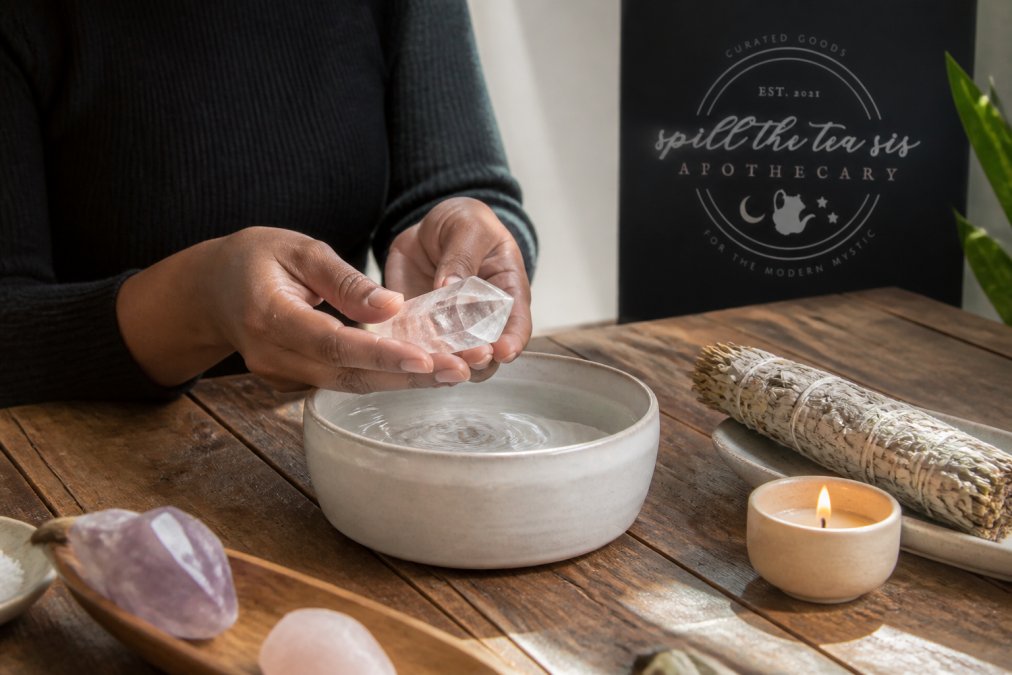
Cleansing clears stuck energy so your crystal can hold a fresh intention. Think of it the way you'd rinse a glass before pouring fresh water, the vessel needs to be empty before it can hold something new. Most practitioners cleanse a new stone right after bringing it home, then again after any intense emotional work, and on a regular rhythm after that.
How Often to Cleanse
There's no single rule, but a workable default is once a month for stones you keep on an altar or shelf, and after every session for stones you actively hold during breathwork, journaling, or grounding. If a stone starts to feel heavy, dull, or just "off" in your hand, that's your cue, cleanse it.
Five Cleansing Methods and When to Use Each
- Moonlight: Leave stones on a windowsill overnight during a full moon, or any clear night if you can't wait for the cycle. Best for soft stones and any crystal you don't want to get wet. The trade-off is timing, you're working around the lunar calendar.
- Smoke: Pass the crystal through sage, palo santo, or incense smoke a few times, turning it so all sides pass through. Fast, works on every stone, and pairs naturally with space clearing. The trade-off is that some people find smoke irritating indoors.
- Sound: Ring a bell, chime, or singing bowl near the stone and let the tone wash over it for 30 to 60 seconds. No water, no smoke, no sunlight, the safest option for delicate stones. The trade-off is that it's the least tactile method, so some people find it harder to feel the shift.
- Water: Rinse under cool running water for about a minute. Only for stones that won't dissolve or soften. The trade-off is that this method damages more stones than any other, so check before you rinse.
- Brown rice or dry salt (in a bowl, not water): Bury the stone in dry rice or dry sea salt overnight, then brush it off. Good for stones that can't touch water. The trade-off is that salt residue can scratch polished surfaces, so use rice for anything with a shine.
Which Stones Should Never Touch Water or Salt
This is where most beginners damage their collection. Selenite, halite, and Himalayan salt lamps dissolve or pit in water. Malachite, azurite, and chrysocolla are soft copper-based stones that dull and can release residue in water. Pyrite and hematite rust. Opal and turquoise can crack or discolor. Mica and labradorite can flake. When in doubt, use sound or smoke, they're safe for every stone.

A Simple Monthly Rhythm
Pick one day a month, the new moon and full moon are common anchors, and cleanse every stone you've used since the last cycle. Set them out together, work through them one at a time, and reset your intention on each one as you put it back. Ten minutes covers a small collection.
Programming Your Stone After Cleansing
A cleansed stone is a blank slate, so this is the moment to give it a job. Hold the stone in your dominant hand, close your eyes, and state your intention in the present tense, "I am grounded," "I sleep deeply," "I speak clearly." Repeat it three times, then set the stone somewhere you'll see it daily. A stone without a stated purpose tends to become decoration; a stone with one becomes a reminder.
Step 2: How to Set Intentions with Candles
Setting intentions with candles turns a vague wish into a focused commitment. The flame holds your attention while the wax burns down slowly, a quiet reminder of what you're working toward.
Choosing Your Candle and Writing Your Intention
Pick a candle whose scent matches your goal. For renewal, the Persephone Candle carries green leaves and damp earth. For divination work, the Ritual Divination Candle blends frankincense and myrrh.
Step 3: Spiritual Grounding Techniques for Beginners
Grounding brings you back into your body when your thoughts spiral. These spiritual grounding techniques for beginners take five minutes or less, and you can do them anywhere.
Three Grounding Practices You Can Do in Five Minutes
- Five senses scan: Name five things you see, four you hear, three you touch, two you smell, one you taste.
- Barefoot contact: Stand on grass, sand, or a wood floor and press your feet down firmly.
- Breathwork: Breathe in for four counts, hold for four, out for six. Repeat ten times.
Breathwork, sometimes called pranayama, calms the nervous system fast. Pair it with a crystal in your palm for a stronger anchor.
Step 4: Clear Your Space with Sage and Incense
Clearing your space resets the room's mood before ritual or rest. Light a hand-wrapped sage bundle and walk slowly through each corner, letting the smoke drift into doorways and closets.
Open a window first. Smoke needs somewhere to go.
Step 5: Build a Daily Practice with Your Spiritual Tools
A daily practice beats an elaborate one you do twice a year. Five minutes every morning can contribute to spiritual growth over time.
A Four-Week Starter Rhythm
Week 1, One tool, one time. Pick a single tool (a candle, a crystal, your breath) and use it for two minutes at the same time each day. Same time matters more than same tool. Morning works for most people because nothing has gone wrong yet.
A Sample Day Using Multiple Tools
- Morning (5 minutes): Light a candle, state one intention, take ten grounding breaths (in for four, hold for four, out for six). Blow out the candle.
- Midday (1 minute): Three grounding breaths between tasks. If you carry a stone, hold it in your pocket hand.
- Evening (5 minutes): Light the candle again, journal one sentence about the day, cleanse your stone with smoke or sound if you used it heavily, blow out the candle.
That's eleven minutes total across the day. It's enough to feel like a practice and short enough to actually keep.
Building a Small Altar
An altar is simply a dedicated surface that signals "this space is for reflection." A corner of a dresser, a windowsill, or a tray on a bookshelf all work. Keep it to five or six items: a candle, one or two stones, a small dish for incense or loose herbs, a journal, and something from nature, a shell, a leaf, a stone you picked up on a walk.
When the Practice Stalls
Every practice stalls. The question is what you do next.
- You're skipping days. Shrink the practice. Two minutes is not too small. A single breath before your coffee still counts.
- It feels empty. Change one variable, the time of day, the tool, the intention. Repetition without meaning is just routine.
- You feel worse, not better. This is common when a practice surfaces something you've been avoiding. Slow down, shorten sessions, and consider talking to a therapist or counselor alongside your spiritual work.
- You're collecting tools instead of using them. Stop buying. Use what you have for thirty days before adding anything new.
Common Mistakes When Using Natural Spiritual Tools
Other pitfalls to avoid:
- Skipping cleansing and wondering why a stone feels heavy
- Setting vague intentions like "be happier"
- Rushing rituals and expecting instant results
- Buying from sellers who can't explain where stones come from
Budget-friendly options exist too. Moonlight, breath, and a library book cost nothing and work just as well as expensive supplies.
Frequently Asked Questions
How do I choose the right spiritual tools for my healing journey?
Start with one tool that matches what you need most. If you feel scattered, try a grounding practice with a crystal or a stirring spoon to anchor your attention. If you want to release something, start with a candle and a written intention. Beginners often do well with a single candle, one crystal, and a cleansing herb like sage. Add tools as your practice grows rather than buying everything at once. The tool matters less than the consistency of your ritual.
Can natural spiritual tools be used for emotional healing?
Yes. Many people use intention candles, crystals, and journaling as part of emotional healing work. These tools can support self-reflection and emotional processing. Lighting a candle with a specific intention, holding a grounding stone, or writing in a journal can help you slow down and sit with what you feel. Pair these practices with therapy or counseling when you are navigating grief, trauma, or persistent anxiety.
How do I cleanse and charge my spiritual healing tools?
Cleanse your tools regularly to clear accumulated energy. For crystals, use one of four safe methods: running water, sound, moonlight, or smoke from sage or incense. Avoid saltwater for softer stones like selenite or malachite because it can damage them. To charge a tool, place it in moonlight overnight or hold it while stating your intention. Candles do not need cleansing, but you can trim the wick and reset your intention before each burn. Cleanse tools whenever they feel heavy or after intense emotional work.
Are there specific spiritual tools for beginners?
Beginners do well with a small, focused set: one intention candle, one grounding crystal like clear quartz or black tourmaline, a bundle of sage or incense sticks for space clearing, and a journal. You do not need an elaborate altar or a large collection. Start with these four items and build a simple daily or weekly ritual. A ritual stirring spoon is also a low-cost way to bring intention into something you already do, like stirring your morning coffee or tea.
Building a spiritual practice takes patience, and the right tools make it easier to stay consistent. Spill The Tea Sis Apothecary offers handcrafted intention candles, ethically curated crystals, and ritual tools designed to support your journey, from the Persephone Candle for renewal to intuitively chosen crystal boxes for beginners. Shop with intention and find the pieces that fit your practice.