


Table of Contents
- What Fair Trade Actually Means for Tarot Cards
- Why Paper Products Get Overlooked in Ethical Sourcing
- How to Tell If Crystals Are Ethically Sourced
- Identifying Counterfeit Tarot Decks: A Visual Guide
- Sustainable Tarot Card Printing: What to Look For
- Certification Marks and Verified Labels That Matter
- Where to Buy Fair Trade Tarot Cards with Confidence
- Frequently Asked Questions
Last Updated: September 19, 2026
What Fair Trade Actually Means for Tarot Cards
Fair trade tarot refers to decks made under verified labor and sourcing standards, not just a marketing label on the box. For buyers, that means checking who made the cards, where the paper came from, and whether a third party confirmed it. This guide from Spill The Tea Sis Apothecary walks through how to identify fair trade tarot cards step by step.
Most people assume "fair trade" only applies to coffee and chocolate. Paper goods rarely get the same scrutiny.
That gap matters. Tarot decks pass through mills, printers, and finishers before they reach your hands. Each step can hide labor or sourcing problems.
Below, we'll show you exactly how to spot the difference between a genuine ethical deck and one that just sounds ethical.
Why Paper Products Get Overlooked in Ethical Sourcing
Paper sits low on the ethical shopping radar because it feels harmless. It isn't tied to mining or factory farming, so shoppers rarely ask where it came from.
But card stock starts as pulp, and pulp comes from forests and mills with their own labor records. Coating, ink, and lamination add more suppliers to the chain.
A common mistake is assuming a recycled logo equals fair labor. It doesn't. Recycling says something about materials, not about who handled them.
So when you check a deck, look past the paper claim. Ask who printed it and under what conditions.
How to Tell If Crystals Are Ethically Sourced
Crystals are ethically sourced when the seller can name the mine or region, describe working conditions, and back it with third-party verification. Without that paper trail, "ethically sourced" is just a phrase.
Start with these checks:
- Ask for the country and region of origin
- Look for a supplier code of conduct
- Check whether the seller visits or audits its suppliers
- See if the listing names the mine, not just the country
- Watch for vague claims like "responsibly gathered"
Mining Conditions and Supply Chain Transparency
Small-scale mining often happens informally, which makes traceability hard. That's not automatically bad, but it means buyers need more proof, not less.
Supply chain transparency means the seller can show each hand-off: mine, cutter, polisher, shipper. Few crystal sellers publish this.
What most guides miss is that a short chain is easier to verify than a long one. A single artisan who cuts and sells locally is simpler to check than a stone that passes through five countries.
If a seller can't answer basic origin questions, treat that as your answer.
Identifying Counterfeit Tarot Decks: A Visual Guide
A counterfeit tarot deck is an unauthorized copy sold as the real thing. You can often spot one by comparing print quality, card stock, and packaging against the original.
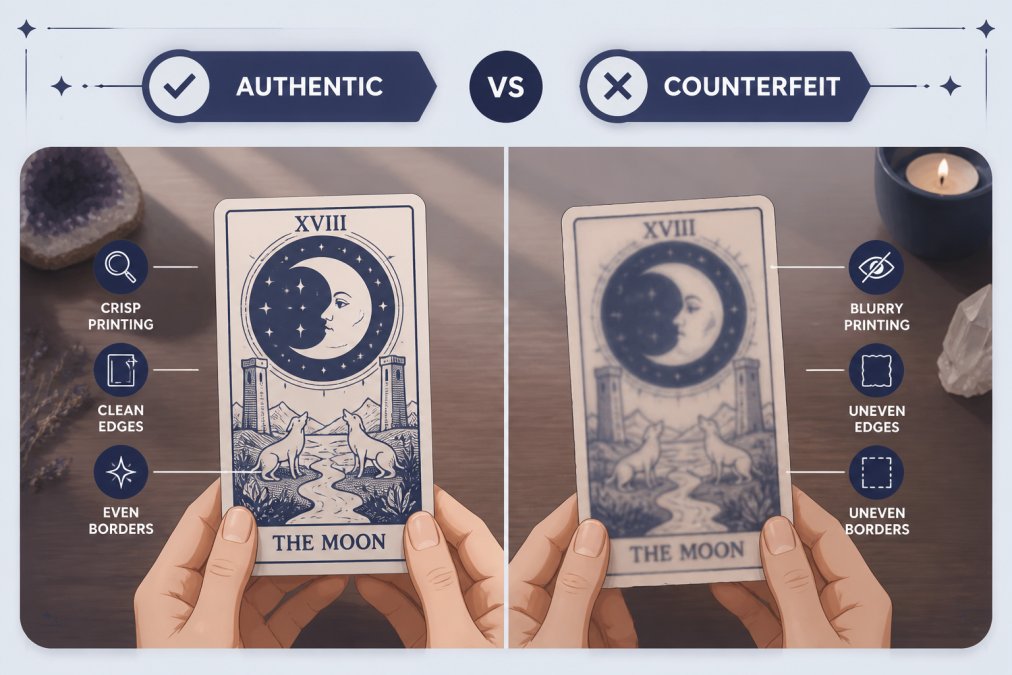
Here's a quick comparison to run before you buy:
| What to Check | Authentic Deck | Counterfeit Deck |
|---|---|---|
| Print sharpness | Crisp lines, true color | Blurry art, muddy color |
| Card edges | Even, clean cut | Ragged or uneven |
| Card stock | Consistent thickness | Flimsy or warped |
| Box quality | Sturdy, well-fitted | Thin, loose, crushed |
| Guidebook | Full text, correct credits | Missing pages, typos |
| Price | Matches retail norm | Suspiciously low |
Print Quality, Card Stock, and Packaging Red Flags
Run your thumb along the edge of a card. A clean cut feels smooth. A cheap cut feels rough or fuzzy.
Hold the deck up to light. Real decks show even opacity. Counterfeits often look patchy or thin.
Packaging tells you a lot too. Counterfeit boxes use lighter cardboard and sloppy glue. Authentic publishers invest in a box that protects the deck.
One more tell: the guidebook. Real decks credit the artist and author by name. Fakes often strip those credits or rush the printing.
Sustainable Tarot Card Printing: What to Look For
Sustainable tarot card printing uses responsibly sourced paper, low-impact inks, and finishes that don't rely on heavy plastic coating. The goal is a deck that lasts without costing the planet more than it should. But the specifics matter more than the buzzwords, and most guides never explain what actually goes into a tarot deck's production.
A tarot deck is a stack of printed card stock, usually between 300 and 400 grams per square meter (gsm) for a quality feel. That card stock starts as pulp from trees, which means paper sourcing is the first sustainability checkpoint. Look for FSC-certified or recycled paper stock. FSC certification ensures the pulp comes from forests managed to protect biodiversity and worker safety. Recycled stock reduces demand for virgin pulp, though it can be harder to source for the thick, coated cards tarot decks often use.
Inks are the second checkpoint. Soy and vegetable-based inks break down more cleanly than petroleum-based ones and are less toxic to workers during printing. They're also easier to de-ink during recycling. Many independent printers now offer soy inks as standard, but ask directly. "Do you print with soy or vegetable-based inks?" is a fair question.
Finishes are the third checkpoint, and this is where tarot decks get tricky.
Certification Marks and Verified Labels That Matter
Forest sourcing certifications:
- FSC (Forest Stewardship Council), verifies that paper stock comes from responsibly managed forests. Look for the FSC 100% or FSC Mix label. FSC Mix means some recycled or controlled wood is blended in, which is common for card stock.
- SFI (Sustainable Forestry Initiative), a North American program that certifies responsible forest management. It's less stringent than FSC on some criteria but still requires third-party auditing.
- PEFC (Programme for the Endorsement of Forest Certification), an umbrella group that recognizes national forest certification systems. FSC and PEFC are separate; a deck can carry one, both, or neither.
Labor and wage certifications:
- Fair Trade Certified, the mark used by Fair Trade USA, which focuses on labor conditions, fair wages, and community development. It's most common in agriculture but applies to some manufactured goods.
- Fairtrade International, a separate system that sets minimum prices and premiums for producer cooperatives. The similar names cause constant confusion; check which organization actually issued the mark.
- SA8000, a social accountability standard that audits factories for child labor, forced labor, health and safety, and working hours. It's less consumer-facing but appears on some printing facilities' disclosures.
Overall business certifications:
- B Corp, certifies that a company meets standards for social and environmental performance, accountability, and transparency. It's a company-level certification, not a product-level one, so a B Corp can still sell a deck made in a non-certified factory.
- GOTS (Global Organic Textile Standard), only relevant if the packaging includes textiles, like a cloth pouch. It doesn't apply to paper.
Third-party verification is the whole point. Without it, you're trusting a claim, not a fact. And for paper goods like tarot decks, the most meaningful certification is usually FSC for the card stock and SA8000 or Fair Trade Certified for the printing facility. If a deck carries neither, ask why.
Where to Buy Fair Trade Tarot Cards with Confidence
Buy fair trade tarot cards from sellers who can name their printers, show certification, and answer sourcing questions without hedging. That combination is rarer than it should be, but it's the clearest signal you'll get.
A few buying habits that help:
- Ask the seller directly about printers and paper
- Cross-check any certification on the certifier's site
- Prefer sellers who publish sourcing details openly
- Support family-owned and women-owned shops when you can
- Buy from independent publishers in small batches
Frequently Asked Questions
How can I tell if a tarot deck is counterfeit?
Counterfeit tarot decks usually show blurry or pixelated artwork, flimsy card stock that bends easily, and misspelled text on the box or guidebook. Check the ISBN against the publisher's website and look for a missing or fake copyright page. Legitimate decks list the publisher, printing location, and edition details. If the price seems unusually low and the seller has no traceable business presence, treat it as a warning sign.
What does the Fairtrade symbol look like on tarot cards?
The Fairtrade Mark is a blue and green yin-yang style symbol with the word 'FAIRTRADE' across it. On paper products, you may also see the FSC (Forest Stewardship Council) logo, which confirms the paper comes from responsibly managed forests. Not all ethical tarot decks carry the Fairtrade Mark because certification for small print runs is expensive, so look for FSC certification, recycled paper claims, and transparent printing disclosures as complementary signals.
Are there specific fair trade standards for paper and printing products?
Yes. Fairtrade International has standards for textile and agricultural products, but paper and printing fall mainly under FSC (Forest Stewardship Council) and PEFC (Programme for the Endorsement of Forest Certification) schemes. These verify sustainable forestry, chain of custody, and responsible manufacturing. Some independent tarot publishers also work directly with printers that hold SA8000 social compliance certification, which covers fair wages and safe working conditions.
How do I know if my tarot cards were produced ethically?
Start by checking the publisher's website for a supply chain transparency statement. Look for named printing partners, FSC or PEFC certification, and details about where the cards were manufactured. Independent publishers often share this information openly. If a seller cannot tell you where the cards were printed or what paper was used, that gap in traceability is a red flag. You can also search the printer's name to see if they have published labor standards or independent auditing reports.
The hardest part of buying ethically isn't finding a deck. It's finding a seller who will tell you the truth about where it came from. Spill The Tea Sis Apothecary curates tarot cards, crystals, and intention candles with that question in mind, and we're glad to walk you through what we carry, from intuitively chosen mystery crystal boxes to handcrafted candles for daily ritual. Shop with intention and build a practice you can feel good about.