


Table of Contents
- Why Tarot Is a Tool for Intuition, Not Fortune-Telling
- What You'll Need Before Your First Intuitive Reading
- Step 1: Ground and Center Before You Touch the Deck
- Step 2: Clear Your Energy and Set an Intention
- Step 3: Intuitive Tarot Reading Techniques for Beginners
- Step 4: Tarot Journaling for Intuition That Grows
- Step 5: Build a Daily Tarot Practice for Beginners
- Troubleshooting Blocked Intuition and Self-Doubt
- Frequently Asked Questions
Last Updated: September 15, 2026
Why Tarot Is a Tool for Intuition, Not Fortune-Telling
Learning how to use tarot cards for intuition starts here: tarot is a tool for intuition, not a machine that predicts a fixed future. Each card gives your subconscious something concrete to react to, and that reaction is where the real information lives. At Spill The Tea Sis Apothecary, new readers always ask: what if I get it wrong? You won't, as long as you stop hunting for the "correct" meaning and start noticing your own response.
Fortune-telling hands your power to the deck. Intuition training hands it back to you. A prediction mindset asks, "What will happen?" An intuitive mindset asks, "What am I noticing, and what does it point to?" One builds dependence on outside answers; the other builds self-trust.
What You'll Need Before Your First Intuitive Reading
You need very little to start: a deck, a flat surface, and ten quiet minutes.
- A deck you like looking at. If the artwork annoys you, you won't use it. Handle a few in person or study images online first.
- A journal. Any notebook works, it becomes your most valuable tool within a month.
- A candle or something that signals "ritual time." A dedicated scent helps your brain shift gears fast.
- A consistent spot. Same chair, same table, same corner. Repetition builds the association.
You don't need to memorize 78 card meanings before your first reading. You need familiarity, not fluency, meanings stick through use, not flashcards.
A scented candle is the fastest way to build that ritual signal. Something like The Moon Tarot Candle works well here because the scent itself becomes the cue that tells your nervous system it's time to slow down and listen.

Step 1: Ground and Center Before You Touch the Deck
Grounding means settling your attention into your body so you're reading from a calm baseline instead of a scattered one. Skipping it is the most common reason readings feel flat.
A 60-Second Grounding Practice
Try this before every reading:
- Sit with both feet flat on the floor. Feel the surface under you.
- Breathe in for a count of four, out for a count of six. Repeat three times.
- Name five things you can see, four you can hear, three you can feel.
- Place both hands on the deck and pause for one full breath before shuffling.
That's it. Sixty seconds, no incense required.
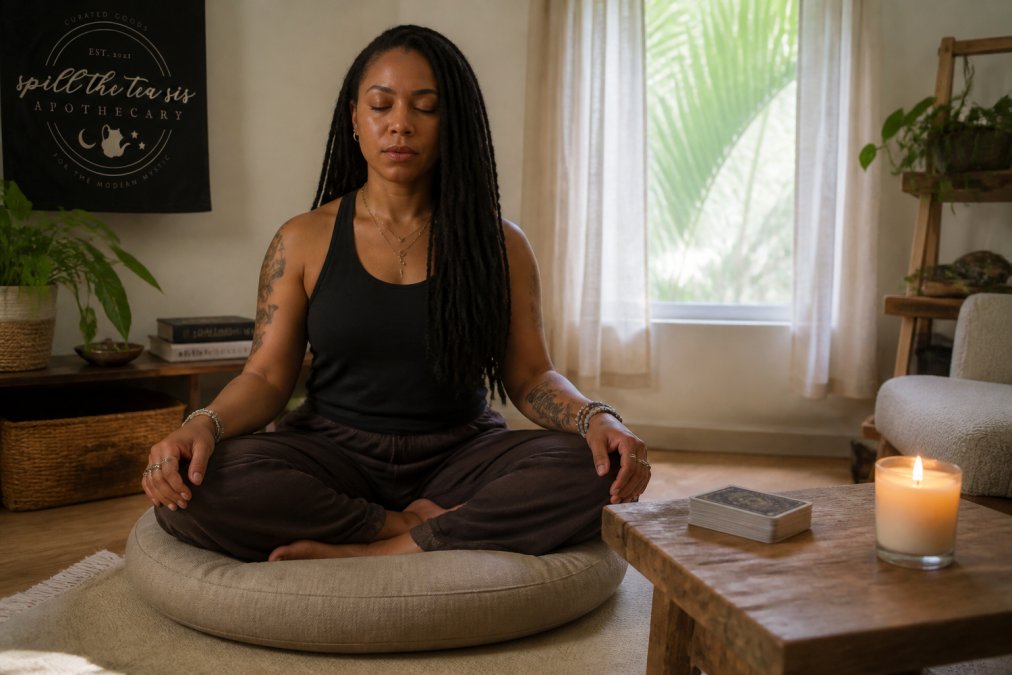
Step 2: Clear Your Energy and Set an Intention
Clearing your energy means releasing whatever you carried into the room so it doesn't color the reading. Setting an intention means deciding, in one clear sentence, what you're actually asking. Clearing can be as simple as:
- Shaking out your hands for ten seconds
- Taking one loud exhale
- Wiping the deck's top card with your palm
- Stating out loud: "I release what isn't mine to carry."
Then set your intention as a real question, not a vague topic. "Should I take the job?" beats "Tell me about my career." Specific questions get specific answers and make journaling easier later.
Step 3: Intuitive Tarot Reading Techniques for Beginners
If you want to know how to use tarot cards for intuition, an intuitive tarot reading technique is any method that prioritizes your direct response to the cards over memorized definitions. The two skills below do most of the heavy lifting.
Trusting Your First Impression
Your first impression arrives before your brain has time to edit it. That's the one to write down. Pull one card and, before reading anything, say out loud what you notice: "She's turning away from something." "There's too much weight on that branch." Say it before you decide whether it's right, the instinct to correct yourself kills intuitive flow fast.
Reading Visual Cues and Symbols
Card imagery carries information that keywords flatten out. Instead of jumping to a definition, scan the card in a fixed order:
- Where are the figures looking? Toward the future, away from something, or directly at you.
- What's the weather and color palette? Bright and open reads differently than grey and closed.
- Where's the weight? Which object or figure draws your eye first, and why.
- What's missing? An empty chair, a closed door, a turned back.
Do this for every card and you'll notice patterns across a spread no guidebook would flag. Archetypes become useful here too: once you recognize recurring figures and themes, you can read a new deck's artwork without relearning the whole system.

The One-Card Daily Pulse: A 5-Minute Intuition Drill
Most articles tell you to trust your gut. This drill trains it, do it daily for two weeks and your impressions will arrive faster and clearer.
The drill:
- Set a timer for 60 seconds. Shuffle and pull one card face down.
- Flip it over. For the first 30 seconds, say out loud every single thing you notice, colors, figures, objects, the feeling in your body. Do not interpret. Just describe.
- For the next 30 seconds, ask yourself: "If this card were a message about my day, what would it be saying?" Write down the first sentence that comes.
- At the end of the day, write one line about what actually happened. Did the card's message connect to anything?
Why it works: This drill forces you to separate observation from interpretation. Most beginners jump straight to meaning, which is where projection sneaks in. Describing first builds the muscle for noticing what's actually there. After about ten days, certain cards will show up on certain kinds of days, not magic, just your brain recognizing patterns it was already picking up on. That recognition is intuition.
The Two-Card Contrast Drill
This drill builds your ability to read card combinations intuitively, one of the hardest skills for beginners.
- Pull two cards at random. Place them side by side.
- Ask: "If these two cards were having a conversation, what would they be saying to each other?"
- Write down a one-sentence dialogue. For example, if you pull the Eight of Cups and the Ten of Pentacles, you might write: "I'm leaving this behind" says the Eight. "But look at everything you've built" says the Ten.
- Notice which card feels like the "speaker" and which feels like the "responder." That dynamic is often the key to the reading.
Why it works: This drill trains you to stop reading cards in isolation. In a real spread, cards talk to each other, the contrast drill makes that conversation explicit so you start hearing it automatically.
The Projection Check
Before you trust an intuitive hit, run it through this quick filter:
- Does it feel quiet or loud? Intuition arrives quietly, often before you want it to.
Step 4: Tarot Journaling for Intuition That Grows
Step 5: Build a Daily Tarot Practice for Beginners
| Step | Time Needed | How Often | What It Builds |
|---|---|---|---|
| Ground and center | 60 seconds | Every reading | Mental clarity |
| Clear energy and set intention | 1-2 minutes | Every reading | Focused questions |
| First-impression practice | 5 minutes | 3-4 times weekly | Self-trust |
| Journaling with outcomes | 2 minutes | Daily | Pattern recognition |
| One-card daily draw | 1 minute | Daily | Consistency |
Troubleshooting Blocked Intuition and Self-Doubt
The Four Types of Blocked Intuition
1. The Blank Mind
2. The Loud Answer You Don't Like
3. The Performance Mode
4. The Wrong Question
The Psychological Perspective: Intuition as Pattern Recognition
What this means in practice:
The Harder Skill: Telling Intuition Apart from Projection
When to Walk Away
Frequently Asked Questions
How do I know if I'm reading intuitively or just guessing?
Intuitive hits arrive before your brain starts explaining. Notice the first image, word, or feeling that surfaces when you look at a card, then check whether your reasoning mind immediately jumps in to justify or dismiss it. Guessing tends to feel effortful and anxious; intuition feels quiet and certain. Track both in your journal for a few weeks. Patterns will show you which one you were following.
Which tarot card represents intuition?
The High Priestess is the classic card for intuition, inner voice, and subconscious knowing. The Moon also speaks to intuition, mystery, and trusting what you sense rather than what you can prove. Pulling either card in a reading often points to a situation where your inner guidance is more reliable than outside advice. Neither card means you should ignore facts; they suggest you check in with yourself before deciding.
Can tarot cards help improve my daily decision-making?
Yes, when you use them as reflection tools rather than prediction machines. A single daily draw gives you a lens for the day: what energy to lean into, what to watch for, what you might be avoiding. The card does not make the decision for you. It surfaces what you already sense and gives you language for it, which makes the choice clearer.
What are the do's and don'ts when reading tarot for intuition?
Do ground yourself first, keep a journal, and trust your first impression. Don't read when you are emotionally flooded, don't memorize meanings at the expense of what you see in the imagery, and don't treat a card as a command. One more don't: don't read the same question repeatedly hoping for a different answer. Sit with the first reading instead.