


Table of Contents
- What Raw Crystals Look Like
- Understanding Polished and Tumbled Crystals
- How to Tell If a Crystal Is Polished
- Crystal Identification at Home: A Practical Checklist
- Distinguishing Polishing From Coatings and Treatments
- Common Mistakes When Identifying Raw vs Polished Crystals
- Build Your Collection With Intention
- Frequently Asked Questions
Last Updated: October 10, 2026
What Raw Crystals Look Like
Raw crystals are natural mineral specimens that haven't been processed or altered from their original formation.
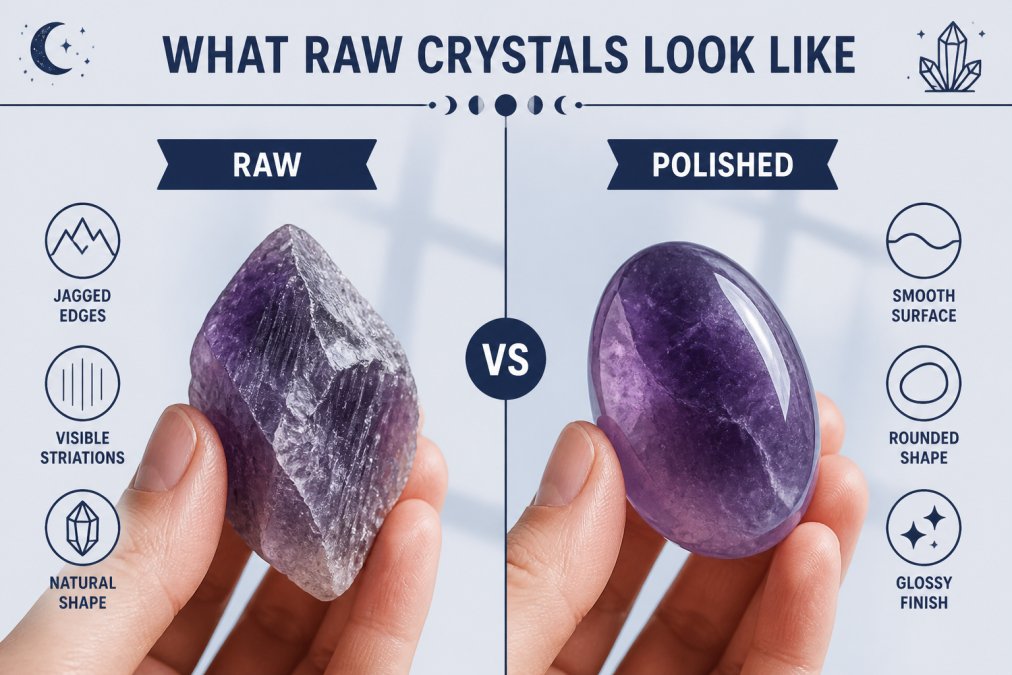
Raw crystal surfaces feel rough and uneven, with natural facets, striations, and small fractures from formation, signatures of authenticity, not flaws. A raw quartz point might have cloudy patches, tiny ridges, and sharp edges where the crystal terminated naturally.
Raw crystals show their true color without enhancement. Amethyst appears in deeper purples with natural color banding, and rose quartz has a soft, milky appearance. Their surfaces scatter light rather than reflecting it smoothly.
At Spill The Tea Sis Apothecary, we curate raw crystals for collectors who value their natural state.
Understanding Polished and Tumbled Crystals
Polished crystals are smoothed and shaped through mechanical processing. Tumbling, the most common method, places raw specimens in rotating drums with progressively finer abrasive materials over weeks or months.
The Tumbling Process and What It Does
Tumbling follows a multi-stage progression: coarse grit (60-80 mesh) removes sharp edges, followed by medium grit (120-220 mesh), fine grit (400-600 mesh), and polish grit (1000+ mesh). Each stage lasts one to two weeks depending on hardness and desired finish.
This removes natural crystal faces and striations, creating uniform glossy luster that reflects light consistently. All edges and corners round into smooth, pocket-safe stones.
Visual Markers of Tumbled Stones
Tumbled stones show specific surface characteristics that distinguish them from raw crystals and from hand-polished or coated specimens:
Directional scratch patterns: Tumbling creates fine, multidirectional scratch lines visible under bright light. Raw crystals lack these uniform patterns; their texture comes from natural formation.
Rounded termination points: Tumbling blunts natural points into rounded tapers, while raw crystals retain sharp points where growth ended.
Consistent surface wear: Tumbled stones show even wear across all surfaces, a hallmark of mechanical tumbling that differs from hand-polishing.
Absence of natural facets: Tumbling eliminates natural crystal faces, replacing them with curved, continuous surfaces.
Color and Transparency Changes
Polished amethyst appears more saturated and transparent, polished rose quartz looks translucent and glowing, and polished citrine becomes golden and luminous. This occurs because smooth surfaces allow light to penetrate and reflect efficiently, while raw specimens scatter light, making colors appear muted.
Tumbled Versus Hand-Polished
Some crystals are hand-polished using lapidary wheels and compounds, showing more surface variation than tumbled stones. Both methods produce uniform luster and lack natural striations of raw crystals.
How to Tell If a Crystal Is Polished
Surface Texture and Finish
Run your finger across the surface: polished stones feel smooth and slick, while raw crystals feel textured with tiny ridges that catch your fingernail.
Polished crystals have consistent, reflective shine, while raw crystals scatter light unevenly. The difference is obvious under bright light.
Polished stones show fine scratch patterns from tumbling running in various directions. Raw crystals lack these uniform patterns.
Edge Shape and Sharpness
Raw crystals have sharp, angular edges with needle-sharp points or natural breaks creating jagged points.
Polished crystals have rounded, smooth edges from tumbling. You can run your thumb safely along the edge without risk of cutting yourself, one of the most reliable markers.
Raw crystals often have sharp points where growth ended naturally. Polished stones have blunt, rounded points that taper gradually.
Luster and Shine Patterns
Raw crystals have "matte" or "dull" luster, with light scattering across the uneven surface rather than reflecting smoothly.
Polished crystals have "glossy" or "vitreous" luster, with smooth surfaces reflecting light like a mirror, making stones appear to glow or shimmer.
Tilt the stone to observe shine patterns: raw crystals show spotty, inconsistent reflection, while polished stones show smooth, flowing patterns.
Crystal Identification at Home: A Practical Checklist
Step-by-Step Inspection Process
Use this process every time you're unsure whether a crystal is raw or polished:
Step 1: Feel the surface (takes 30 seconds) Run your bare finger across the stone. Does it feel rough or smooth? Rough = raw. Smooth = polished.
Step 2: Examine under bright light (takes 1 minute) Hold the crystal under a lamp or near a window. Look at how light bounces off it. Does light scatter randomly or reflect smoothly? Random scatter = raw. Smooth reflection = polished.
Step 3: Check the edges (takes 30 seconds) Feel the edges carefully. Are they sharp and angular or rounded and soft? Sharp = raw. Rounded = polished.
Step 4: Look for striations (takes 1 minute) Raw crystals show visible striations (natural lines or ridges). Polished crystals have these worn away.
Step 5: Assess overall appearance (takes 1 minute) Step back and look at the whole stone. Does it have a dull, matte appearance or a shiny, glossy one? Dull = raw. Glossy = polished.
Total time: about 4-5 minutes for a thorough inspection.
Mystery Crystal Box | Intuitively Chosen Crystal Gift →
| Inspection Point | Raw Crystal | Polished Crystal |
|---|---|---|
| Surface feel | Rough, textured | Smooth, slick |
| Light reflection | Scattered, uneven | Smooth, consistent |
| Edge shape | Sharp, angular | Rounded, soft |
| Visible striations | Clear and visible | Worn away or minimal |
| Overall luster | Matte or dull | Glossy or shiny |
What to Look For in Each Crystal Type
Different crystals show their raw versus polished state in distinct ways.
Quartz (clear, smoky, or rose): Raw quartz has visible inclusions, cloudiness, and sharp termination points. Polished quartz becomes transparent or translucent and glows under light.
Amethyst: Raw amethyst shows natural color banding and striations. The purple appears in layers. Polished amethyst has uniform, saturated color with a glossy finish.
Citrine: Raw citrine has a pale yellow color with visible natural facets. Polished citrine appears golden and luminous.
Fluorite: Raw fluorite shows distinct color layers and natural cubic formations. Polished fluorite becomes smooth and the color bands appear more vivid.
Distinguishing Polishing From Coatings and Treatments
Not all shiny crystals are polished. Some are coated with resin, paint, wax, or other surface treatments to enhance appearance or mask lower quality. Others are dyed, irradiated, or heat-treated to intensify color. Understanding these distinctions matters if you're seeking authentic, unaltered specimens.
Common Surface Treatments and How They Differ From Polishing
Resin or epoxy coatings: Applied as liquid layers that harden, resin coatings create plastic-like shine that feels sticky or tacky, especially in warmth. True polishing feels dry and smooth. Resin-coated crystals show visible seams where coating was applied and may peel when scratched with a fingernail.
Wax or oil coatings: Create a slick, greasy feel and may leave residue on fingers. Wax coatings dull over time, while polished surfaces maintain consistent luster.
Paint or lacquer: Lower-quality specimens are painted to hide fractures or discoloration. Paint shows brush marks or uneven application under magnification and may chip with handling.
Dyed crystals: Dyes intensify or alter color and often concentrate in fractures or edges. Dyed amethyst may appear unnaturally saturated, lacking natural color banding. Natural polished crystals show color variations reflecting genuine internal structure.
Irradiated and heat-treated stones: Some crystals are irradiated or heated to enhance color. Irradiated citrine, for example, may appear too golden or uniform compared to naturally colored specimens. Heat-treated amethyst can lose its natural purple banding.
Non-Destructive Home Tests for Authenticity
The fingernail test: Run your fingernail across the surface. True polishing slides smoothly without catching. Coatings feel raised or sticky and may peel. Dyes may transfer color or concentrate in cracks.
The water test: Dampen a soft cloth and wipe gently. Polished crystals dry smooth. Wax-coated crystals leave residue or feel slick. Resin coatings show tackiness or discoloration.
The magnification test: Use a 10x magnifying glass to examine closely. Polished crystals show uniform scratch patterns and smooth surfaces. Coated crystals reveal brush marks or seams. Dyed crystals show color pooling in fractures.
The light-reflection test: Hold under bright light and tilt slowly. Polished crystals show smooth, flowing light patterns. Coated crystals show glare spots or uneven reflections. Dyed crystals show color variation corresponding to cracks or inclusions.
When Visual Inspection Is Not Enough
Some treatments cannot be detected at home. Irradiation and heat treatment produce permanent color changes. Ask reputable sellers whether crystals have been treated, as this affects value and durability.
Be cautious of crystals described as "enhanced" or "treated" without specifics. If a seller cannot clearly state whether a crystal is raw, polished, or treated, that is a red flag.
Common Mistakes When Identifying Raw vs Polished Crystals
Mistake 1: Assuming all rough crystals are raw. Some polished crystals are intentionally left with a slightly textured finish from less intensive tumbling. Feel the overall smoothness before concluding it's raw.
Mistake 2: Mistaking natural fractures for polishing damage. Raw crystals have natural breaks from formation, part of the stone's history, not damage.
Mistake 3: Judging by color alone. Polished crystals appear more colorful because polishing reveals true color by smoothing the surface. A vibrant polished amethyst is still natural.
Mistake 4: Expecting perfect uniformity in polished stones. Even polished crystals show texture variation. Some areas may feel slightly rougher without indicating the stone is raw.
Mistake 5: Overlooking the edges. Many people focus on the flat surfaces and miss the edges. Edge shape is one of the most reliable markers. Always check the edges carefully.
Build Your Collection With Intention
Choose raw or polished crystals based on personal practice and aesthetic preferences. Raw crystals appeal to those seeking unaltered specimens. Polished crystals work well for daily carry, altar work, or display.
When you're ready to expand your collection, our Mystery Crystal Box at Spill The Tea Sis Apothecary offers an intuitive way to discover new specimens. Each box contains 2-4x the value of what you pay, carefully selected with intention.

Our Zip Code Mystery Box offers additional flexibility. You can customize your box to include crystals only or crystals plus apothecary items, and specify up to three intentions like abundance, peace, or love.
Now that you understand how to identify raw versus polished crystals at home, you can make choices that align with your spiritual practice. Your intuition about which stones call to you matters more than whether they're raw or polished.
The difference between raw and polished crystals shapes how they fit into your practice. Whether you're drawn to the natural authenticity of raw specimens or the refined beauty of polished stones, our curated selection, including our intuitively chosen Mystery Crystal Box, helps you find exactly what your practice needs.
Frequently Asked Questions
What is the main difference between raw and polished crystals?
Raw crystals retain their natural formation with sharp edges, uneven surfaces, and natural crystal faces. Polished crystals have been smoothed and rounded through tumbling or sanding, creating a glossy, uniform finish. Raw specimens show the mineral's original striations and cleavage patterns, while polished stones lose these surface details through the finishing process.
How can I tell if a crystal has been polished without special tools?
Run your finger gently across the surface. Polished crystals feel smooth and uniform throughout, while raw crystals have varied textures with sharp edges and rough spots. Examine the edges closely: polished stones have rounded, blunt edges, whereas raw crystals have pointed or jagged edges. Look at the luster too; polished crystals shine uniformly, while raw ones have matte or inconsistent shine.
Can a crystal be partly raw and partly polished?
Yes. Some specimens are intentionally left partially raw to showcase natural crystal faces while being polished on other sides for display. This mixed finish is common in collector pieces. You'll see a clear distinction between the rough, unpolished areas and the smooth, glossy polished sections on the same stone.
How do I identify raw gemstones versus polished ones by appearance alone?
Raw gemstones display natural striations, visible cleavage lines, and color variation across the surface. They have a coarse, grainy texture and dull finish. Polished gemstones look uniform in color, have a consistent glossy or matte finish, and lack visible striations. Polished edges are always smooth and rounded, never sharp or jagged like raw specimens.