


Table of Contents
- The Real Cost of Fair Trade Spiritual Jewelry
- Benefits of Fair Trade Jewelry: More Than Just Ethics
- How to Tell If Crystals Are Ethically Sourced
- The Spiritual Value Proposition: Does Ethical Energy Matter?
- Cost-Per-Wear: Why Quality Handcrafted Jewelry Lasts Longer
- How to Verify Ethical Claims Without Certification
- Conclusion
- Frequently Asked Questions
Last Updated: September 23, 2026
The Real Cost of Fair Trade Spiritual Jewelry
Ask whether is fair trade spiritual jewelry worth it and you'll get two answers. The first comes from your wallet. The second comes from the maker's hands. This guide from Spill The Tea Sis Apothecary is about the second answer, and why it tends to outlast the first.
Here's the honest math.
Benefits of Fair Trade Jewelry: More Than Just Ethics
The benefits of fair trade jewelry split into two categories most buyers never separate: who it helps and what it's made from. Both matter, and both show up in the quality of the piece you wear.
Artisan Empowerment and Fair Wages
Fair wages do something specific. They keep a craft alive. When a maker earns enough to stay in business, traditional techniques survive instead of disappearing. Many buyers find that artisan-made pieces carry small irregularities, and those irregularities are proof of handwork, not defects. Community development follows the same logic: a stable workshop trains apprentices, and those apprentices become the next generation of makers.
Environmental Impact and Recycled Metals
Recycled metals reduce the demand for newly mined material, which lowers the environmental footprint of a piece. Sustainable materials like reclaimed silver and brass are common in small-batch production. The catch? "Recycled" is easy to claim and hard to verify, so you need to know what questions to ask.
How to Tell If Crystals Are Ethically Sourced
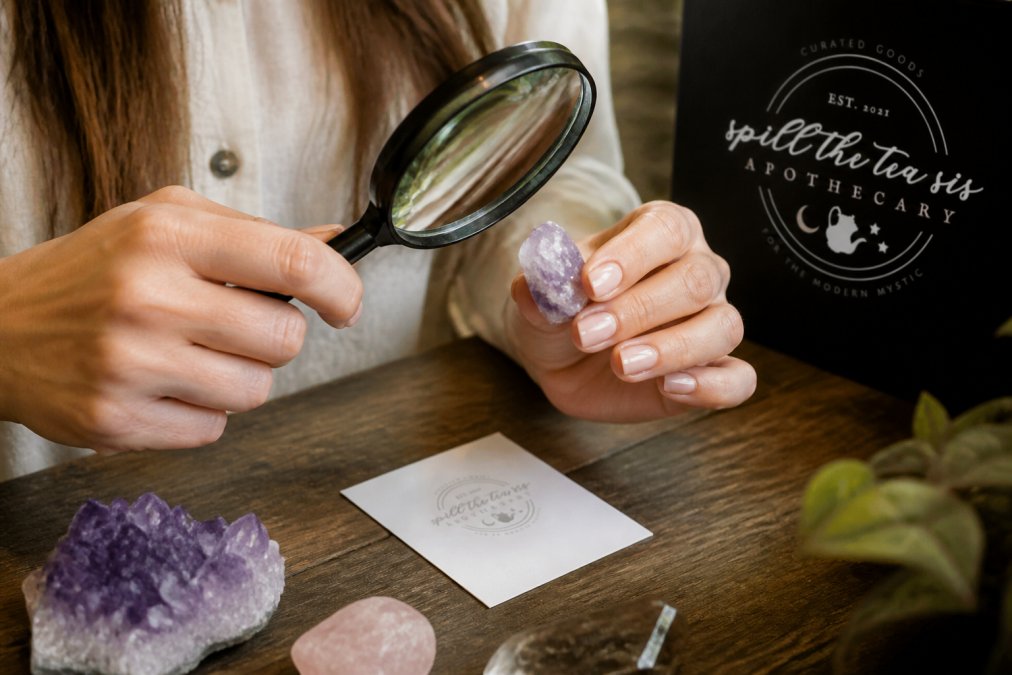
Knowing how to tell if crystals are ethically sourced comes down to one thing: traceability. If a seller can name the region, the mine, or the maker, that's a good sign. If they can only say "sourced responsibly," that's marketing, not proof.
Start with these checks:
- Ask for the country or region of origin, not just "ethically sourced"
- Request the name of the mine, cooperative, or maker
- Look for Fairmined or Fair Trade certification standards where applicable
- Check whether the seller publishes a sourcing policy
- Notice whether the answer is specific or vague
Certifications and Supply Chain Transparency
Supply chain transparency means a seller can trace a stone from the ground to the shelf. Certification standards like Fairmined exist for this exact purpose. Not every small maker can afford certification, though, and that's a real limitation. A maker with a direct relationship to a mine may have better traceability than a certified middleman.
Questions to Ask Before You Buy
- Where was this stone mined, and who mined it?
- Is the metal recycled or newly mined?
- Is this piece handmade by you, or sourced from another maker?
- If sourced, how do you verify the maker's working conditions?
- Can you show me documentation?
A seller who answers these without hesitation is usually telling the truth. A seller who deflects isn't.
The Spiritual Value Proposition: Does Ethical Energy Matter?
For many practitioners, the answer is yes, and not for mystical reasons alone. Intentional jewelry carries meaning because you know its origin story. A stone mined under fair working conditions, shaped by a paid artisan, and sold by someone who can name the maker holds a different weight than a mass-produced charm.
Cost-Per-Wear: Why Quality Handcrafted Jewelry Lasts Longer
Cost-per-wear is the honest way to compare jewelry. Divide the price by the number of times you'll actually wear it. A cheaper piece you wear twice costs more per wear than a handcrafted piece you wear for years. That single formula answers most of the "is it worth it" question before you ever look at a price tag.
| Factor | Mass-Produced | Handcrafted Fair Trade |
|---|---|---|
| Typical lifespan | Months to a year | Years with care |
| Repairability | Rarely repairable | Often repairable by maker |
| Material quality | Plated base metal, thin chain | Solid recycled silver or brass |
| Cost-per-wear over 5 years | Rises after breakage | Falls with each wear |
| Origin story | Unknown | Traceable to maker |
| Resale or heirloom potential | None | Often passed down |
What You're Actually Paying For
When you buy fair trade, part of the price is labor. A fair wage for a maker is a real line item, not a rounding error. That's why a handcrafted piece can cost more than a factory equivalent even when the raw materials are similar. You're paying for the hours, the skill, and the fact that the person who made it was paid enough to keep making things.
Blackthorn's Book of Sacred Plant Magic →
How to Verify Ethical Claims Without Certification
Most fair trade spiritual jewelry is sold by small makers who can't afford formal certification. That doesn't mean their claims are false, it means you have to verify them yourself. This is the step-by-step process for doing that, and for catching the greenwashing that's now common in the spiritual jewelry market.
Step 1: Separate the Claim From the Proof
A claim is a sentence. Proof is a document, a name, or a relationship. "Ethically sourced" is a claim. "This moonstone comes from a women's cooperative in Rajasthan that we've bought from since 2019" is proof. Train yourself to hear the difference. If a seller's sourcing page is three paragraphs of values language with no place names, you have a claim, not proof.
Step 2: Run the Specificity Test
Ask one question: Where did this stone come from? Then listen for the level of detail.
- Strong answer: a country plus a region, mine, or cooperative name, "recycled sterling from a refiner in New Mexico" or "labradorite from a family-run mine in Madagascar."
- Medium answer: a country only, "sourced from India." Better than nothing, but not traceable.
- Weak answer: "ethically sourced," "responsibly mined," "conflict-free," or "our supplier." These phrases have no fixed legal meaning in the jewelry trade and can be applied to almost anything.
Step 3: Check the Metal's Paper Trail
Recycled metal is one of the easiest claims to verify because refiners issue documentation. Ask whether the metal is recycled or newly mined, and whether the seller can name the refiner. Fairmined is a real certification standard for artisanal and small-scale mining, and it applies to gold specifically, if a seller claims Fairmined silver, that's a red flag, because the standard doesn't cover it.
Step 4: Look for the Greenwashing Signals
Greenwashing in this market follows a few predictable patterns. Watch for:
- Stock photos of "artisans" that appear on multiple unrelated websites. Reverse-image search them.
- No names anywhere. Real small makers name themselves, their workshops, and often their teachers.
- Certification logos with no certificate number. Legitimate certifications are verifiable.
- "Handmade" used loosely. Ask whether the seller made the piece or curated it from another maker. Both are fine, conflating them is not.
- Inconsistent claims. If the website says one origin and the social media captions say another, the sourcing story is being improvised.
Step 5: Ask a Follow-Up Question
The single best test is a second question. Ask who made this piece and then ask something specific about the answer, how long they've worked with that maker, what region the maker is in, what technique they use. Sellers with real supply chains answer easily. Sellers with invented ones stall, pivot to values language, or stop responding.
A short verification checklist:
- Seller names a specific region, mine, or cooperative
- Seller can explain the metal's origin (recycled or Fairmined)
- Seller distinguishes between handmade and curated pieces
- Seller answers follow-up questions without deflecting
- Seller's claims stay consistent across their site and social media
Conclusion
The real question isn't whether fair trade spiritual jewelry costs more. It's whether the piece you buy still means something in five years. Mass-produced items rarely do. Handcrafted pieces from verified makers often do.
Frequently Asked Questions
What does fair trade certification actually mean for jewelry?
Fair trade certification for jewelry verifies that artisans receive fair wages, work in safe conditions, and use environmentally responsible practices. It also ensures supply chain transparency, so you can trace materials back to their source. While certification isn't mandatory, it provides third-party proof that a brand's ethical claims are legitimate. Without it, you rely on the brand's own statements, which may be vague or unverified.
How can you tell if spiritual jewelry is ethically sourced?
Start by asking the seller where materials come from and who made the piece. Look for certifications like Fairmined or Fairtrade, which verify ethical sourcing. Check for supply chain transparency on the brand's website. If a brand can't answer basic questions about origin or working conditions, that's a red flag. Also, be wary of prices that seem too low; they often signal exploitation somewhere in the chain.
Does the energy of a piece change if it is ethically made?
Many spiritual practitioners believe that the energy of an object reflects the conditions under which it was made. If a piece was created through fair wages and respectful practices, it may carry a more positive, intentional energy. While this is a matter of personal belief, buying ethically can deepen your connection to the item, knowing it didn't cause harm. That peace of mind can enhance your ritual practice.
What are the environmental benefits of fair trade jewelry?
Fair trade jewelry often uses recycled metals and sustainable materials, reducing mining impact and waste. Artisans typically work in small batches, which lowers the environmental footprint compared to mass production. Ethical sourcing also discourages destructive mining practices that pollute water and soil. By choosing fair trade, you support a supply chain that values the planet alongside people.