


Table of Contents
- What Makes a Spiritual Practice Sustainable?
- The Link Between Inner Wisdom and Global Responsibility
- How to Tell if Crystals Are Ethically Sourced
- Conscious Spiritual Consumerism: Aligning Purchases with Values
- Reconnecting with the Natural World Through Daily Ritual
- Long-Term Spiritual Growth Strategies for Lasting Change
- Overcoming Barriers to Sustainable Living
- Conclusion: Creating a Legacy of Conscious Action
- Frequently Asked Questions
Last Updated: September 26, 2026
What Makes a Spiritual Practice Sustainable?
Sustainable spiritual practices are routines you can maintain over years without exhausting your time, money, or emotional energy. At Spill The Tea Sis Apothecary, the seekers who last are those whose rituals fit their real lives.
Most spiritual burnout comes from intensity rather than rhythm. A ritual you can repeat on a Tuesday after work beats a ceremony you manage twice a year.
Sustainable spirituality rests on three pillars: personal, ecological, and ethical.
The Three Pillars: Personal, Ecological, and Ethical
Personal sustainability asks whether a practice fits your schedule, budget, and emotional capacity. A ten-minute grounding ritual is sustainable; a two-hour ceremony every morning is not.
Ecological sustainability asks what your practice takes from the natural world. Where your herbs, candles, and crystals come from shapes your altar's footprint.
Ethical sustainability asks who benefits from your practice. Fair labor, honest sourcing, and community support sit at the center of conscious spiritual consumerism.
When all three align, your practice becomes a rhythm you live inside.
The Link Between Inner Wisdom and Global Responsibility
Inner wisdom and global responsibility connect through a simple mechanism: what you practice privately shapes what you demand publicly. Someone who builds reverence for the natural world into daily ritual carries it into purchasing decisions, voting, and community involvement.
This is inner-outer alignment, the quiet engine behind spiritual ecology. You cannot separate how you treat a crystal from how you think about the land it came from.
The same principle shows up in the broader sustainability movement. The United Nations frames its Sustainable Development Goals around the idea that individual behavior and systemic change reinforce each other, not compete. You can read the framework directly at United Nations Sustainable Development Goals.
Spiritual values like interconnectedness and groundedness give that framework emotional weight. Policy tells you what to do. Practice reminds you why it matters.
The Mechanism: How Private Ritual Becomes Public Action
The mechanism is habit transfer: repeating a behavior builds neural pathways that make similar behaviors easier elsewhere. A daily grounding ritual that includes noticing one natural detail trains your attention toward the environment, and that attention shows up when you read a label, choose a product, or vote on a local land-use measure.
This is behavioral science applied to spiritual practice: the same way a gratitude journal changes how you notice positive events, a nature-attuned ritual changes how you notice ecological trade-offs.
From Personal Practice to Collective Impact
Collective impact starts with shared practices. When a community adopts similar sustainable rituals, the demand signal shifts: sellers notice, supply chains adapt, and spiritual consumerism becomes a lever for change rather than a personal lifestyle choice.
Consider refillable candle containers or plastic-free incense packaging. These changes came not from legislation but from practitioners asking better questions and refusing to buy otherwise, inner wisdom scaling into global responsibility.
A Framework for Assessing Your Own Alignment
Use these three questions to check whether your practice closes the inner-outer gap or widens it:
- Does my practice make me more aware of where my tools come from, or less?
- Do my spiritual purchases reflect the values I claim to hold?
- Am I using ritual as an escape from the world or as a way to engage with it more honestly?
Answering these honestly is more useful than any certification or label.
Blackthorn's Book of Sacred Plant Magic →
The Role of Community and Accountability
Inner wisdom grows faster in community. Practicing alongside others who share your values brings accountability and new ideas; a local or online circle discussing ethical sourcing, seasonal eating, or low-waste ritual keeps you honest in ways solitary practice cannot.
How to Tell if Crystals Are Ethically Sourced
- Can the seller name the country or region of origin?
- Do they describe mining conditions or supplier relationships?
- Is there any documentation, even informal, of the supply chain?
- Does the seller acknowledge what they do not know?
- Are prices realistic for the stone's actual rarity?
- Does the seller talk about labor, not just energy?
If a shop cannot answer basic sourcing questions, treat that as your answer. Walk away, or buy from someone who can.
Conscious Spiritual Consumerism: Aligning Purchases with Values
Conscious spiritual consumerism means treating every spiritual purchase as a values decision, not just an aesthetic one. The tool you choose carries the story of how it was made, and that story becomes part of your practice whether you think about it or not.
The Value of Handcrafted Tools and Intention
Handcrafted tools carry intention at every stage: the maker's choice of materials, the time spent pouring or carving, the small irregularities that prove a human made it.
| Approach | What It Prioritizes | Trade-Off |
|---|---|---|
| Mass-produced tools | Low cost, wide availability | Unknown sourcing, no maker accountability |
| Handcrafted tools | Traceable materials, human intention | Higher price, limited quantity |
| Foraged or homegrown | Zero shipping, local ecology | Requires knowledge and time |
Measuring the Impact of Your Spiritual Purchases
Most spiritual consumerism advice stops at "buy less, buy better." You need a way to measure whether your purchases align with your values. Here is a simple impact framework for any spiritual item:
- Origin transparency: Can you name the country or region where the raw materials were sourced? If not, that is a gap.
- Labor visibility: Do you know whether the people who mined, harvested, or assembled the item were paid fairly? If not, assume they were not.
- Lifecycle footprint: What happens to this item when you are done with it? Is it compostable, refillable, or destined for a landfill?
- Practice longevity: Will this tool support your practice for years, or is it a short-term trend?
The Role of Small-Batch and Local Makers
Small-batch makers often have the most transparent supply chains because they cannot hide behind layers of subcontractors. Buying from a local artisan lets you visit their workspace, meet the maker, and ask directly about sourcing, proximity mass production cannot replicate.
When to Buy New and When to Reuse
Conscious consumerism does not mean buying everything handcrafted. Sometimes the most sustainable choice is what you already own: a chipped mug becomes a candle holder, an old scarf an altar cloth. Before you buy, ask whether you can repurpose something at home.
A Note on Greenwashing in Spiritual Markets
The spiritual marketplace is full of vague claims. "Ethically sourced," "natural," and "eco-friendly" are not regulated terms in this industry, so the burden falls on you to ask specific questions. A seller who cannot tell you where their herbs were grown or who poured their candles is not necessarily lying, but they are not giving you enough information to choose consciously.
Reconnecting with the Natural World Through Daily Ritual
Practical daily rituals for sustainability can be simple:
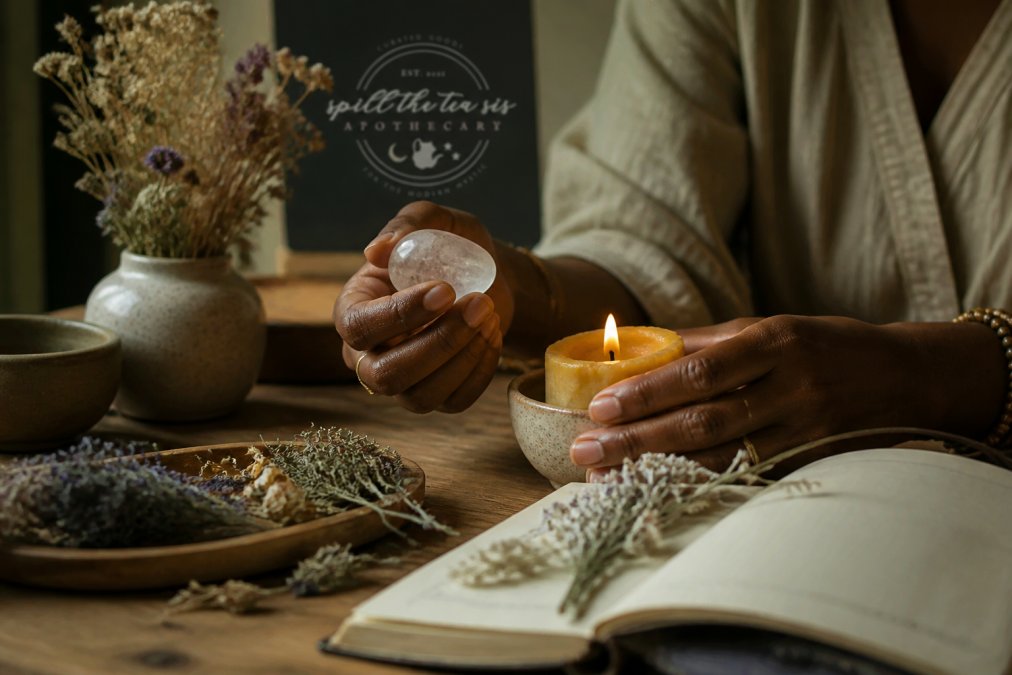
- Step outside barefoot for two minutes each morning and notice one thing that changed since yesterday.
- Keep a small dish of seasonal items on your altar, replacing them as the Wheel of the Year turns.
- Burn a candle at the same time each evening as a marker for the day's close.
- Journal one sentence about what you noticed in the natural world.
- Choose one ingredient in your practice that you foraged, grew, or sourced locally.
If you are coming from a practice built around big ceremonial events, expect the shift to feel underwhelming at first. It is not. It is just quieter.
Long-Term Spiritual Growth Strategies for Lasting Change
Long-term spiritual growth strategies work by building in flexibility, not rigidity. Practices that cannot adapt to a move, an illness, or a busy season collapse when life gets complicated.
- Anchor practices: short, non-negotiable, doable in under five minutes
- Seasonal practices: tied to the Wheel of the Year or lunar cycles
- Occasional practices: larger rituals for milestones, grief, or celebration
Overcoming Barriers to Sustainable Living
Overcoming barriers to sustainable living usually comes down to cost, access, and doubt. Each has a workable answer.
Conclusion: Creating a Legacy of Conscious Action
Sustainable spiritual practices ask for patience in a culture that rewards speed. Building around ethical consumption, daily ritual, and long-term growth means accepting slower results in exchange for something that lasts.
Frequently Asked Questions
What defines a sustainable spiritual practice?
A sustainable spiritual practice is one you can maintain long-term without burnout or depletion. It aligns your inner values with your outer actions, considering the ecological and ethical impact of your tools and rituals. This means choosing items like ethically sourced crystals or handcrafted candles and building habits that support your well-being and the planet's health consistently.
How does ethical sourcing impact spiritual energy?
Ethical sourcing is a practice that aligns with integrity. When a crystal or candle is made without harming people or the environment, it reflects a commitment to conscious choices. Prioritizing conscious spiritual consumerism helps you align your practice with your values and supports a more connected, intentional spiritual experience.
How do I know if my spiritual habits are sustainable?
Your spiritual habits are sustainable if they bring you peace and grounding rather than stress or financial strain. Ask yourself if your practices are consistent, if they align with your values, and if they support your long-term growth. If you feel drained or pressured to constantly buy new items, it may be time to simplify and focus on long-term spiritual growth strategies that prioritize connection over consumption.
Why is consistency important in spiritual development?
Consistency builds the foundation for deep spiritual growth. Just as physical muscles need regular exercise, your spiritual connection strengthens with repeated, mindful practice. Whether it's a daily candle ritual or weekly tarot reflection, showing up regularly helps you develop a stronger sense of inner wisdom and groundedness, making it easier to navigate life's challenges with clarity and purpose.