


Last Updated: October 26, 2026
Quick Summary
Choosing between tarot or oracle cards comes down to whether you want a fixed system with centuries of tradition or a flexible deck that speaks in its own language. Tarot is a structured 78-card system with fixed meanings, while oracle cards are free-form decks whose card count, themes, and interpretations vary from deck to deck.
- Tarot's 78 cards split into 22 Major Arcana and 56 Minor Arcana across four suits.
- Oracle decks follow no universal structure, so meanings do not transfer between decks.
- Most beginners can give a meaningful oracle reading on day one using the guidebook.
- A practical middle path is starting with oracle for daily draws, then adding tarot.
- In combined readings, let tarot carry the structure and oracle carry the message.
Table of Contents
- Tarot vs. Oracle: The Core Difference Between Tarot and Oracle Cards
- Side-by-Side Comparison: Structure, Symbols, and Learning Curve
- Tarot or Oracle Cards for Beginners: Which Is Easier to Learn?
- How to Choose an Oracle Deck That Fits Your Practice
- How to Use Tarot and Oracle Cards Together in One Reading
- Realistic Expectations: Limitations and Ethics of Card Reading
- Find Your Deck at Spill The Tea Sis Apothecary
- Frequently Asked Questions
Tarot vs. Oracle: The Core Difference Between Tarot and Oracle Cards
Choosing between tarot and oracle cards comes down to one question: do you want a fixed system with centuries of tradition behind it, or a flexible deck that speaks in its own language?
Below is a side-by-side look at both systems to help you decide which fits your practice right now.
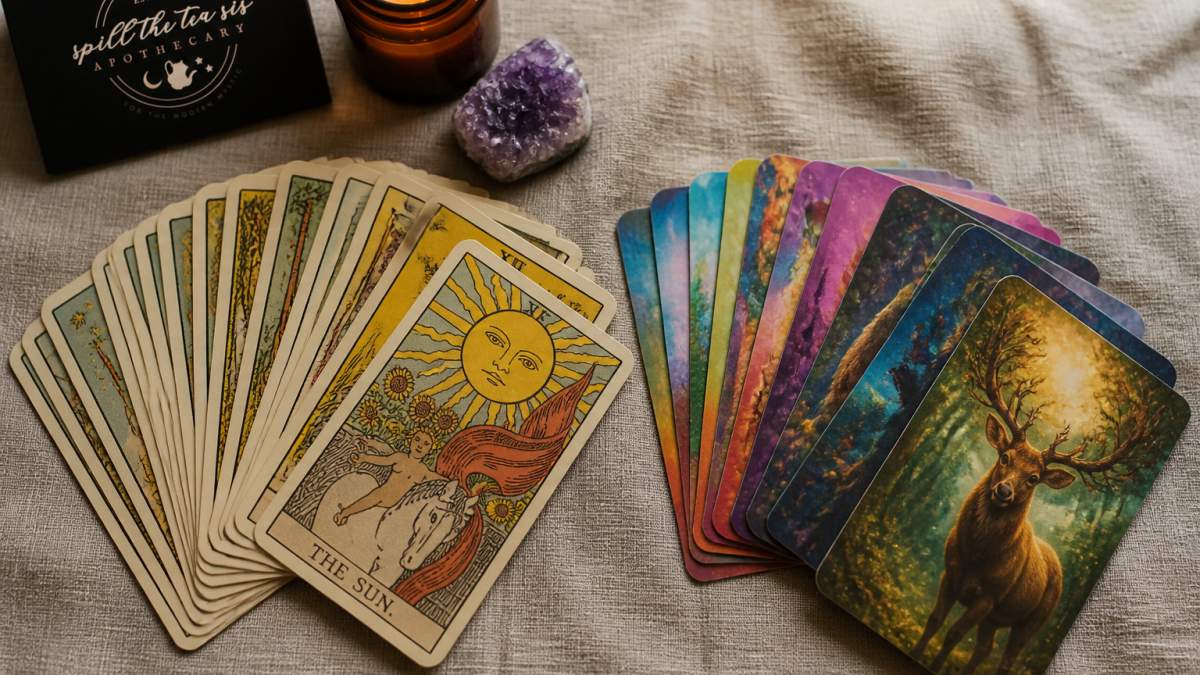
Tarot: A Fixed 78-Card System
Tarot is a divination system built on 78 cards split into two groups. The Major Arcana holds 22 cards representing big life themes and archetypes. The Minor Arcana holds 56 cards divided into four suits, and those suits carry the everyday details of a reading.
Because the structure is fixed, card meanings stay fairly consistent across decks. Learn the Fool in one tarot deck and you can read the Fool in another.
If you are leaning toward tarot, consider card stock, artwork style, and guidebook quality before you buy.
Oracle: A Free-Form, Open-Ended Deck
Oracle decks follow no universal structure. A deck might hold 44 cards, 60 cards, or any other number the creator chose.
That freedom is the appeal. Oracle cards tend to read as open-ended messages, encouragement, or prompts for self-reflection rather than a detailed map of a situation. The trade-off is portability: a meaning you learn in one oracle deck will not transfer to another.
Side-by-Side Comparison: Structure, Symbols, and Learning Curve
The clearest way to see the difference between tarot and oracle cards is to line them up against the criteria that actually affect your reading practice.
| Criteria | Tarot | Oracle |
|---|---|---|
| Deck structure | Fixed 78 cards | Varies by deck |
| Card groups | Major and Minor Arcana, four suits | No standard groupings |
| Meaning system | Consistent across decks | Defined per deck |
| Learning curve | Steeper, builds over months | Gentler, learnable in days |
| Reading style | Detailed, layered interpretation | Open-ended, intuitive messages |
| Best for | Structured study and deep readings | Quick guidance and daily draws |
The symbols differ too. Tarot leans on traditional symbolism, numerology, and the four suits, so a single card can carry several layers of meaning.
Neither approach is deeper than the other. They simply ask different things of the reader.
Tarot or Oracle Cards for Beginners: Which Is Easier to Learn?
Oracle cards are easier to learn. Most beginners can shuffle an oracle deck and give a meaningful reading on day one, because each card's guidebook entry does the interpretive work for you.
That does not mean beginners should avoid tarot. Plenty of readers start with tarot precisely because they want a system to study. The question is whether you want a gentle entry or a structured one.
A Decision Guide Based on Your Goals
Most comparisons stop at "oracle is easier." That is true but not useful when you are standing in a shop trying to decide. Use your goal to pick the deck:
- Daily reflection and quick check-ins: Choose oracle. A one-card draw in the morning takes seconds, and the guidebook gives you a prompt without requiring memorization.
- Detailed readings on a specific situation: Choose tarot. The 78-card structure lets you lay a spread that maps past, present, and future, or examines a decision from multiple angles.
- Learning divination as a craft: Choose tarot first. The fixed meanings and shared framework give you a foundation that transfers across decks and deepens over years.
- Building intuition without study pressure: Choose oracle. The open-ended imagery invites you to respond to what you see rather than recall what a book says.
- Reading for others casually: Choose oracle. Guests at a gathering can pull a card and receive an encouraging message without a lengthy interpretive session.
What the Learning Curve Actually Looks Like
A common pattern among new readers: oracle decks feel usable within a day, while tarot decks feel usable within a month of daily practice. The difference is not intelligence but structure.
A practical middle path: begin with an oracle deck for daily draws, then add tarot once the habit of reading is established. If you want a step-by-step starting point, look for guidance on your first reading, from shuffle to interpretation.
A Quick Self-Check Before You Buy
Ask yourself three questions:
- Do I want to study a system, or do I want a prompt for reflection today?
- Am I drawn to traditional symbolism, or to a specific theme like animals or seasons?
- Will I feel frustrated if I cannot read a card without the guidebook?
If you answered "study," "traditional," and "no," tarot is your deck. If you answered "prompt," "theme," and "yes," oracle is the better fit.
How to Choose an Oracle Deck That Fits Your Practice
Choosing an oracle deck is more personal than choosing tarot, because there is no shared standard to fall back on. The deck's theme, artwork, and guidebook are the whole system, so evaluate all three before you commit.
Evaluate the Artwork for Readability
Oracle cards rely on a single strong image, so the artwork does most of the interpretive work. A deck that looks beautiful online may be hard to read in practice. Look for:
- Clear focal points. Can you tell what the card is about at a glance, or is the image busy and ambiguous?
- Emotional resonance. Does the artwork make you feel something, or does it leave you flat? A deck you respond to emotionally will read better than one you chose for its theme alone.
- Visual accessibility. Are the colors distinct enough to tell cards apart? Is the imagery readable for people with low vision or color blindness?
- Inclusive representation. Does the deck depict a range of bodies, ages, and cultures, or does it repeat a single narrow ideal? This matters if you want readings to feel welcoming to a broad range of people.
Check the Guidebook Depth
The guidebook is the deck's instruction manual, and its quality varies widely. A deck with gorgeous art and a thin guidebook will frustrate you. Before buying, look for:
- A full page per card. Short one-line entries are common in mass-market decks and leave you guessing.
- Interpretations that go beyond keywords. Good guidebooks explain how a card might show up in different contexts, not just what it means in isolation.
- A clear tone. Does the guidebook speak in a way that matches how you want to read, gentle, direct, playful, or ceremonial?
Assess the Physical Deck
Card stock and size affect how often you actually use a deck. A deck that is uncomfortable to shuffle will sit on the shelf. Consider:
- Card size. Standard oracle cards are often larger than tarot cards, which can be hard to shuffle for people with smaller hands.
- Card stock. Thick, matte stock feels luxurious but can be stiff; thinner stock shuffles easily but may wear faster.
- Finish. Glossy cards slide; matte cards grip. Neither is better, but your preference matters.
- Box quality. A sturdy box protects the deck; a flimsy one does not survive daily use.
Match the Theme to Your Practice
Oracle deck themes range from animal spirits to affirmations to moon phases. A themed deck works best when the theme matches what you want guidance on.
The Beasties Oracle Deck is a themed deck with 44 animal spirit cards, four special spirit cards tied to earth, air, fire, and water, a 150-page guidebook, and hand-crafted artwork.

Best for: readers who want wild, playful guidance with a strong theme. Skip if: you prefer a neutral, traditional system with no strong personality.
How to Use Tarot and Oracle Cards Together in One Reading
Combining both decks in a single reading is one approach a reader can try. The usual approach is to let tarot carry the structure and oracle carry the message.
Try this three-step method:
- Lay a small tarot spread to map the situation, such as a three-card past, present, and future.
- Draw one oracle card as the closing message or action step.
- Read the oracle card in light of the tarot spread rather than on its own.
The tarot gives you the detail. The oracle gives you the nudge. To go further, read about using tarot cards for intuition.
Realistic Expectations: Limitations and Ethics of Card Reading
Card reading is a tool for self-reflection, not a guarantee of outcomes. A reading can be used to reflect on a situation and consider what to do next. It cannot predict the future with certainty or make decisions for you.
A few ethical guardrails worth keeping:
- Never use a reading to make medical, legal, or financial decisions for someone else.
- Do not read for a person who has not asked for it.
- Be honest that a reading reflects interpretation, not fact.
- Avoid framing cards as commands. They are prompts for thought.
Cards can be part of a daily ritual: a quiet moment to check in with yourself.
Find Your Deck at Spill The Tea Sis Apothecary
One way to explore the tarot or oracle cards question is to hold a deck in your hands. Our shop offers a curated selection of tarot items alongside oracle and affirmation decks, including the hand-crafted decks described in our catalog.
We built this space for people exploring intuition and ancestral roots, whether you are one reading in or ten years deep. The shop is described as a sanctuary for people exploring intuition and ancestral roots.
Frequently Asked Questions
Should I get tarot or oracle cards first?
Consider oracle cards if you prefer a deck whose cards have their own messages. Choose tarot if you want a structured system with 78 cards, four suits, and the Major and Minor Arcana that rewards steady study. Many readers keep both: oracle for daily encouragement and tarot for deeper self-reflection. Your goal matters more than the deck's reputation.
Is oracle easier to learn than tarot?
Oracle decks are free-form, and their themes and interpretations vary by deck. Tarot follows a fixed system of 78 cards split into 22 Major Arcana and 56 Minor Arcana across four suits. The two formats offer different structures for readers to explore.
Can you use tarot and oracle cards together in one reading?
You can try using both decks, giving each a distinct role. A common approach is to pull tarot cards for the situation and its underlying patterns, then draw one oracle card as closing guidance or an action step. Keep the decks separate in the spread so you do not blur their roles. If you are new to both, learn one system first, then add the second deck once readings feel natural.
How do I choose an oracle deck that fits me?
Look at three things: theme, artwork, and guidebook quality. Consider whether you enjoy the deck's imagery and theme. Check the card count and guidebook length, since a 44-card deck with a 150-page book offers more depth than a 30-card set with one-line meanings. Flip through sample cards before buying and notice which ones you react to.
Deciding between tarot and oracle cards does not have to be a permanent choice. Start with the deck that fits where you are right now, and let your practice grow from there. Spill The Tea Sis Apothecary offers hand-crafted oracle decks, tarot cards, and intention candles to support that journey, with artwork made by our small team and packaging that respects the earth. Get started with Spill The Tea Sis Apothecary and find the deck that meets you where you are.
