


Last Updated: November 7, 2026
Quick Summary
Artists create independent tarot decks to keep full creative control over the artwork, packaging, and guidebook, free from publisher art directors and sales projections. Independent tarot decks let creators choose small print runs, personal symbolism, and their own voice, though the artist also carries the funding, printing, and distribution burden.
- Traditional publishing often routes a deck through art directors, marketing teams, and sales projections before readers see it.
- Crowdfunding has become a common launch path for creative projects that might never attract a traditional publisher.
- Successful indie decks keep card names, suit divisions, and general meanings intact while changing the visual language.
- Changing card names or suit structures without clear guidebook explanation is the most common way a deck loses readers.
- Buying directly from artist-run shops gives creators a larger share of income than marketplace listings.
Table of Contents
- Creative Freedom Outside Commercial Publishing Constraints
- Why the Rise of Indie Tarot Decks Changed the Market
- Personal Connection and Visual Storytelling Through the Major and Minor Arcana
- What Makes Handmade Tarot Decks Different From Mass-Market Decks
- The Role of Tarot Decks With Guidebook in an Artist's Vision
- From Concept to Print Run: Costs, Funding, and Creation Timelines
- How to Support Independent Artists and Find Their Decks
- Frequently Asked Questions
Creative Freedom Outside Commercial Publishing Constraints
Artists create independent tarot decks because traditional publishing rarely lets a creator control the final product. A deck made through a major publisher often passes through art directors, marketing teams, and sales projections before it reaches a single reader. Independent tarot decks skip that funnel entirely.
That freedom shows up in small decisions. An illustrator can choose a strange color palette, a handmade card back, or a guidebook written in her own voice. She can print a small run instead of a mass quantity. She can decide the deck belongs in a paper-wrapped box rather than a plastic one.
At Spill The Tea Sis Apothecary, our own decks, including the Beasties Oracle Deck, are hand-crafted by a small team and wrapped in paper rather than plastic.
The tradeoff is real. Creative control usually means the artist also handles funding, printing, and distribution. Many creators accept that burden because the alternative, losing the deck's personality, feels worse.
Why the Rise of Indie Tarot Decks Changed the Market
The indie tarot boom reshaped how readers shop. A decade ago, most decks came from a handful of large publishers. Today, deck creators launch through crowdfunding, sell directly to their audiences, and build loyal communities around a single release.
This shift matters for buyers. Independent decks now sit beside mass-market ones on many shelves, and readers have started seeking them out on purpose. According to Kickstarter's publishing category overview, crowdfunding has become a common launch path for creative projects that might never attract a traditional publisher.
For anyone wondering where to find these decks, our guide on where to buy authentic tarot decks walks through the most trustworthy sources.
The change also raised expectations. Readers now ask harder questions about who made a deck, how it was printed, and whether the artist was paid fairly. That pressure pushed the whole category toward more transparency.
Personal Connection and Visual Storytelling Through the Major and Minor Arcana
An artist's connection to the cards usually starts with the Major Arcana. Those 22 cards carry the big archetypes: the Fool, the Tower, Death, the Star. Reinterpreting them lets an illustrator pour personal symbolism into familiar frames. But the real design tension, and the part most competitors skip, is how a creator balances tradition with originality and usability.
The Major Arcana are the easiest place to go bold because readers expect the archetypes to be recognizable even when the imagery is new. A creator can set the Tower in a modern cityscape or replace the Star's traditional figure with a personal symbol, and experienced readers will still find the card's meaning. The Minor Arcana offers a different kind of freedom. Its 56 cards cover daily life, and creators often rebuild the suits around their own visual language. One artist might replace swords with feathers. Another might set the whole deck in a specific landscape or era.
Visual storytelling is the thread tying it together. A strong independent deck reads like a single illustrated world, not a stack of unrelated pictures. Card design, color, and recurring motifs do the work that a written narrative would in a novel. This is also where readers feel personal connection. A deck that reflects an artist's worldview gives the reader something to respond to. The archetypes stay recognizable, but the interpretation feels new.
The usability question is where creators make hard choices. A deck that departs too far from traditional symbolism can confuse readers who rely on familiar cues. A deck that copies tradition too closely can feel like a reprint. Most successful independent decks solve this by keeping the structure intact (same card names, same suit divisions, same general meanings) while changing the visual language and the guidebook's voice. The guidebook becomes the bridge between the artist's vision and the reader's expectations.
Watch out: changing card names or suit structures without clear explanation in the guidebook is the most common way an independent deck loses readers who expected a standard tarot structure.
If you are weighing deck styles, our comparison of tarot or oracle cards can help you decide which structure suits your reading practice.
What Makes Handmade Tarot Decks Different From Mass-Market Decks
Handmade tarot decks carry visible evidence of the maker. You can often feel it in the card stock, see it in the printing, and read it in the guidebook's tone. Mass-market decks prioritize consistency and volume. Handmade decks prioritize character.
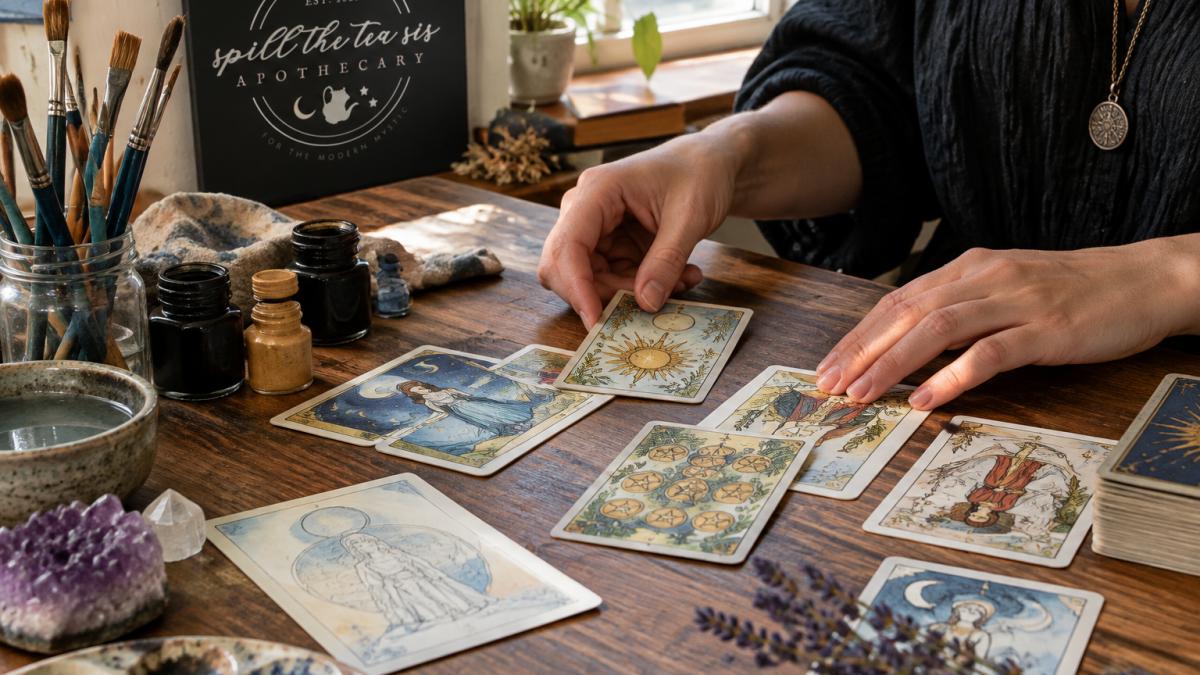
The differences usually show up in a few places:
- Print runs: small batches instead of large quantities
- Artwork: original illustration rather than licensed or stock imagery
- Packaging: paper wraps, handmade boxes, and small extras
- Guidebooks: written by the artist, often in a personal voice
A common mistake buyers make is assuming handmade means amateur.
You can browse a curated collection of tarot items to see how these details play out across different decks.
The Role of Tarot Decks With Guidebook in an Artist's Vision
A tarot deck with guidebook lets the artist explain what the images mean. Without one, readers project their own interpretations onto the cards, which is fine for experienced readers but confusing for beginners. The guidebook closes that gap.
For the creator, writing the guidebook is often the hardest part. It forces her to articulate her symbolism, her card meanings, and her reading approach. Many artists say the guidebook became the place where the deck's concept finally clicked.
Our Beasties Oracle Deck includes a 150-page guidebook alongside 44 animal spirit cards. You can see how that works on The Beasties Oracle Deck page.

A good guidebook does three things well: it explains the imagery, offers practical reading guidance, and sounds like the artist who made the deck.
From Concept to Print Run: Costs, Funding, and Creation Timelines
The creation timeline for an independent deck is longer and more expensive than most people expect. Concept development and research can take months. Illustration often stretches across a year or more. Prototyping, printing, and shipping add further time on top. But the real story is in the money and the trade-offs, which is where most deck projects succeed or stall.
A rough sequence looks like this:
| Stage | What Happens | Typical Duration |
|---|---|---|
| Concept development | Theme, symbolism, card structure | 1-3 months |
| Research and sketching | Reference gathering, rough drafts | 2-6 months |
| Final illustration | Completed artwork for every card | 6-18 months |
| Prototyping | Test prints, card stock, box design | 1-3 months |
| Printing and fulfillment | Production run, packing, shipping | 2-4 months |
Typical Duration
Funding is the second hurdle, and it is where the financial risk sits squarely with the artist. Many creators cover costs through crowdfunding, pre-orders, or savings. Others fund a small first print run and reinvest the proceeds into a larger one. The financial risk sits with the artist, which is why independent decks often cost more than mass-market ones.
A common pattern is to break the budget into three buckets: artwork and design (often the largest if the artist hires an editor or designer), printing and packaging, and fulfillment and shipping. Printing costs scale with card count, card stock weight, box style, and whether you choose a traditional offset run or a shorter digital run. A test print before committing to a full run is the single most reliable way to catch problems early, and most creators budget for at least one round of revisions.
Crowdfunding is not free money. A successful campaign still requires the creator to deliver on time, manage backer communication, and absorb any production delays. Many creators run a small first print run to test demand before scaling, which keeps the financial exposure manageable while proving the deck has an audience.
How to Support Independent Artists and Find Their Decks
Supporting independent artists starts with buying directly when you can. Direct sales give creators a larger share of the income than marketplace listings, and they keep the relationship between maker and reader intact.
A few practical ways to find and support indie tarot decks:
- Follow deck creators on social media and sign up for their launch announcements
- Buy from artist-run shops and small metaphysical retailers
- Leave honest reviews, which help small creators get discovered
- Ask who made the deck before you buy
If you are ready to act, you can buy handcrafted tarot decks online and support the artists behind them directly.
Community matters here too. Many deck creators build their audience through readings, workshops, and local events.
The independent tarot market only works when readers choose decks made by real people. That is the challenge we take on at Spill The Tea Sis Apothecary: offering handcrafted decks, intention candles, and intuitively chosen crystal boxes that support your practice rather than talking down to it. Our small team designs and prints original artwork in-house, wraps every deck in paper instead of plastic, and writes guidebooks in our own voice. If you want tools that feel made for you, get started with Spill The Tea Sis Apothecary and shop with intention.
Frequently Asked Questions
Is it okay to make your own tarot deck?
Yes. Plenty of readers and artists build their own decks, and there is no authority that governs who can create one. Many creators start by reinterpreting traditional imagery in a personal sketchbook, then move to a full 78-card project once the concept holds together. What matters is that the symbolism stays readable enough for you to use the cards in a reading practice. If you plan to sell the deck, budget for printing, a guidebook, and a print run before you commit.
What makes independent tarot decks different from a mass-market deck?
Independent tarot decks are self-published, which means the artist controls the artwork, the card stock, the guidebook, and the print run. A mass-market deck is shaped by a publisher's timeline and sales targets. On an indie deck you often see a single visual style carried across all 78 cards, hand-crafted artwork, and a guidebook written by the creator rather than a hired writer. Print runs are smaller, so decks can sell out and not return.
How do artists turn their artwork into a tarot deck?
Most start with concept development: choosing a theme, deciding how closely to follow traditional imagery, and sketching the Major Arcana first. From there it is research, prototyping, and a full set of illustrations, then a guidebook, then printing. Costs sit in the illustration hours and the print run. Many creators fund the print run through crowdfunding or preorders, which also proves demand before they pay a printer.
Why do artists create independent tarot decks instead of pitching a publisher?
Creative freedom is the main reason. Self-publishing lets an artist keep their own visual storytelling, choose the archetypes they want to reinterpret, and write a guidebook in their own voice. It also keeps direct income in their hands instead of a royalty split. The tradeoff is that the creator carries the financial risk of the print run and handles distribution, marketing, and shipping themselves.
